
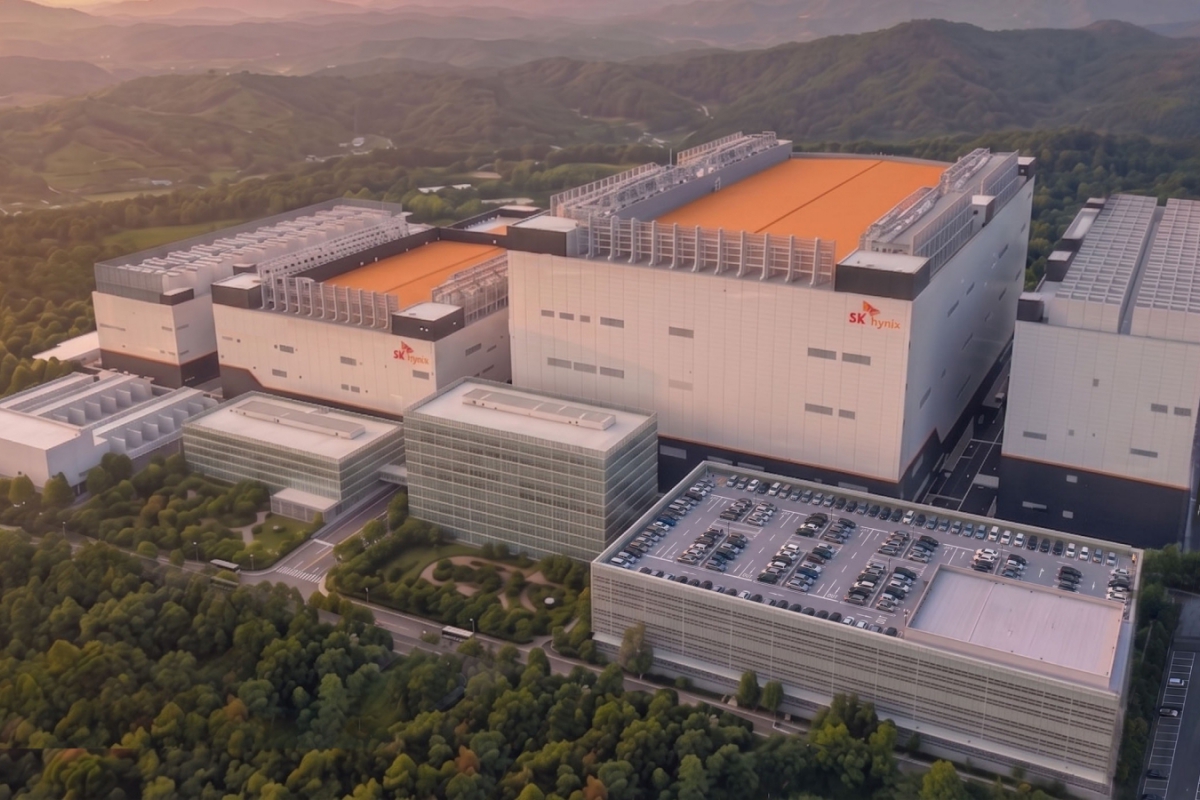
SK Hynix will invest 33.8 billion euros in two new plants to ensure the supply of memory for AI
South Korean manufacturer SK Hynix has approved an investment plan of about 33.8 billion euros (54 trillion won) to build two semiconductor factories in South Korea. The operation will allocate 22 billion euros to the Y2 plant in Yongin and 11.8 billion euros to the M17 facility in Cheongju. The company seeks to guarantee the supply of memory for AI in the face of growing demand in the massive computing sector.
The company points out that the current demand for semiconductors does not respond to an expansive time cycle, but rather to a structural transformation where memory determines the final performance of the systems. According to estimates by the consulting firm Omdia, the demand for DRAM and NAND memories will maintain a compound annual growth of 19% until 2030. The ability to deliver within the required deadlines has become the main competitive factor in the industry.
Yongin Y2 plant to take over production of next-generation DRAM memory and HBM modules
The Y2 factory will stand as the second of four planned plants within the Yongin mega industrial complex. With an area of 1.13 million square meters, construction work will begin in July 2027 to enable its first clean room in June 2029. The facilities will manufacture advanced DRAM memory and HBM modules aimed at graphics accelerators and processors for intensive computing tasks in data centers.
The investment plan for the Yongin plant will be extended gradually until October 2031, including the construction of support infrastructure, testing centers and integrated research. This project is in addition to the works on the Y1 factory, whose clean room plans to begin operations in February 2027. The manufacturer plans to advance the Yongin master plan by twelve years, completing the four facilities planned for the year 2033 instead of 2045.
The development of basic infrastructure in Yongin is in an advanced phase, with 99% of the water pipes and electrical network already completed for the first phase. This simultaneity in the works seeks to avoid bottlenecks during the deployment of industrial equipment. The investment contemplates the creation of an integrated R&D center to consolidate materials analysis and experimentation prior to mass manufacturing.
Cheongju M17 will strengthen the manufacturing of NAND storage and SSD drives for servers
In the flash memory segment, SK hynix will channel 11.8 billion euros to build the M17 plant on the Cheongju campus. Work will begin in February 2027 and the opening of its first clean room is scheduled for December 2028. The new factory will focus on the production of NAND memories intended for enterprise SSDs, driven by the expansion of mass storage and inference applications.
The choice of Cheongju responds to the immediate availability of land and infrastructure already deployed for the M11, M12 and M15 factories. The plant will occupy an area of 680,000 square meters and will maintain the execution of its budgets until April 2031. The integration with existing facilities will optimize deployment costs and shorten the times necessary to launch the storage production lines.
As AI models evolve toward autonomous systems, adoption of technologies such as key-value caching to speed up calculations is increasing. The company highlights that the investment seeks to take advantage of opportunities in line with the speed of the market and contribute to the stability of the global supply chain of semiconductors over the next few years.
To maximize capital efficiency, the manufacturer will execute the construction of the buildings according to the established schedule, but will condition the installation of the machinery to the actual orders of its customers. The pace of expansion of production capacity will be adjusted to the specific needs of the industry, guaranteeing operational flexibility that allows it to react to possible fluctuations in hardware demand.
