
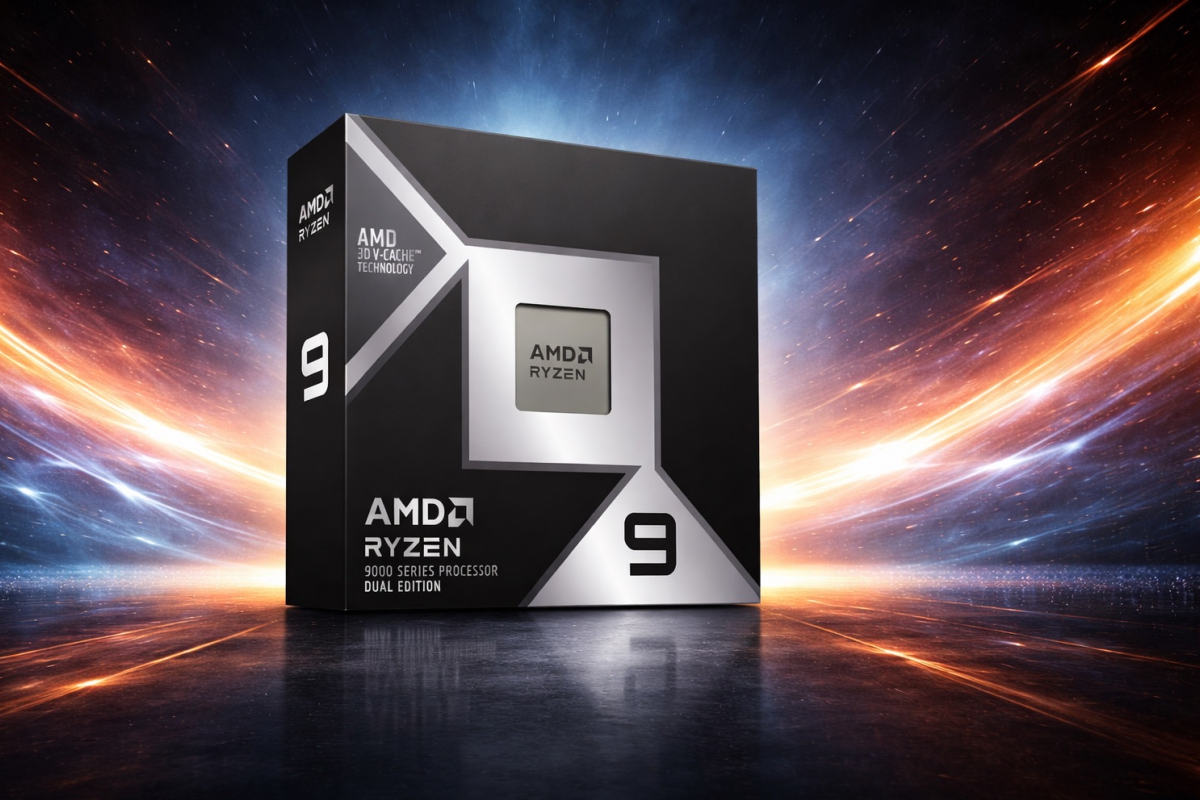
AMD opens orders for the Ryzen 9 9950X3D2 in China and makes it clear that its commitment is no longer just to play: local AI and creation, other objectives
AMD has begun to make a move with one of its most striking processors of this generation: the Ryzen 9 9950X3D2, a model that has started pre-sales in China and that comes with an idea quite different from that usually associated with the surname X3D. For years, talking about a Ryzen with 3D V Cache was talking above all about gaming. This new chip, however, opens up a broader reading: more cache, more ambition in productivity and an evident intention to stretch its appeal towards profiles that do not live only from games.
The key is in its design. Unlike previous generations, where the 3D V Cache was placed on only one of the chiplets, the 9950X3D2 mounts that stacked cache on both CCDsbecoming AMD’s first X3D with that dual configuration. The result is a total of 208 MB cache and a technical approach that seeks to go beyond the typical “CPU to play better.” In fact, the product’s own orientation also points to creators, developers and workloads where a more generous cache hierarchy can make a difference.
The X3D surname changes its role within AMD’s high-end
The interesting thing about this release is that it modifies the way in which the X3D family is interpreted. Until now, the proposal was pretty clear: if the main focus was gaming, the X3D made sense; If the priority was pure productivity, there were more logical models within the Ryzen 9 range. With the 9950X3D2, AMD begins to blur that border.
The chip maintains a base of 16 coresbut changes the distribution of internal resources by placing the 3D cache in the two core complexes. This decision raises the potential in tasks where quick access to data may be more important than it appears in a conventional technical sheet. At the same time, it raises the thermal and energy bar, because This model is going at 200 W TDPa figure above that of the standard 9950X3D and which makes it clear that here we are not dealing with a minor or conservative version. AMD wants to sell it as an unapologetically premium product.
More cache, more price and much more aggressive segmentation
That ambition is also evident in the price. AMD has priced the Ryzen 9 9950X3D2 at $899that is to say, 200 dollars more than the Ryzen 9 9950X3D at launch. The rise is neither small nor coincidental. It is a way of saying that this processor does not come to replace the previous one, but to place itself above it as a more exclusive product, with a narrative focused on advanced users who want the maximum without looking too much at the final cost.
That’s where a relevant detail comes in.: The 9950X3D2 doesn’t seem to be looking for an immediate gaming hit equivalent to the leap its name suggests. The first published references point to more visible improvements in certain productivity and data science scenarios than in pure gaming, where the gain can be much more modest.
AMD expands role of advanced desktop
This movement is also better understood if you look at the general context. The high-end desktop PC is no longer competing just to be the best gaming machine. It also competes for editing, rendering, working with local AI models, programming, compiling and handling mixed workflows where the user goes from gaming to heavy lifting without changing equipment.
Besides, AMD maintains support for AM5which helps ensure that these types of launches do not require a total breakup of the platform. For the user who is already within the Ryzen 7000 or 9000 ecosystem, the proposal becomes much more tempting: paying a lot, yes, but without having to rebuild half a PC from scratch. It also retains support for DDR5 5600so the leap is in the processor, not in a total redesign of the environment.
The pre-sale in China also has a market reading
That pre-sale has started in China is not just any detail either.. The Chinese market has long been a very useful place to measure initial interest, price elasticity and enthusiastic user reaction to especially expensive or peculiar launches. If AMD has chosen that starting point to open orders, it is because it knows that this model needs both technical validation and commercial pulse.
In a market where it is increasingly difficult to truly surprise in desktop CPUs, AMD has found a way to do it: not just increasing the frequency or the number of cores, but by altering the logic of one of its most recognizable surnames. The 9950X3D2 does not seem destined to become the most popular processor of the year. But it may end up being one of the most revealing about where AMD wants to go in its enthusiast range.
