
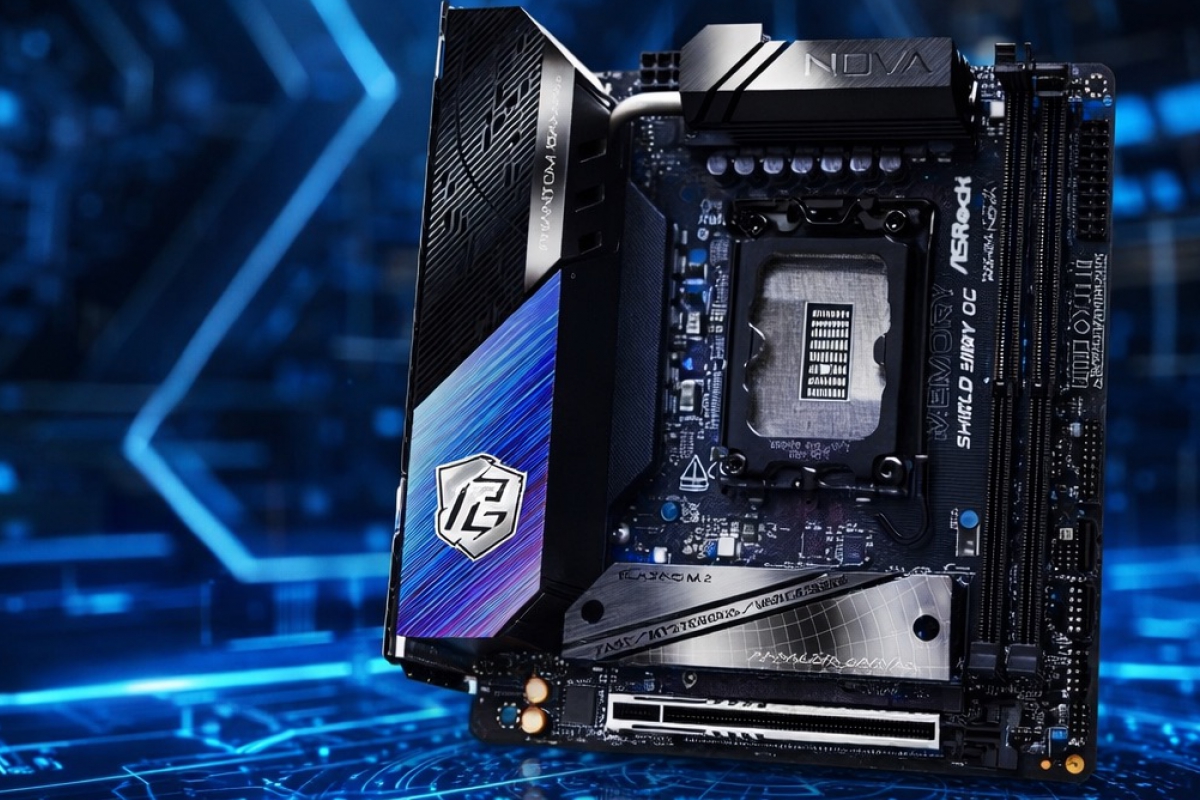
ASRock breaks the memory ceiling in Mini ITX with the Z890I Nova WiFi R2.0 and 256 GB of DDR5 at 7400 MT/s
ASRock has presented one of those demonstrations that attract attention for what they say about the market and for the type of product in which they are obtained. Your motherboard Z890I Nova WiFi R2.0in Mini ITX format, has managed to enable CQDIMM support with two 128 GB Kingston DDR5 modules to reach a total of 256 GB at 7,400 MT/s, exceeding the limit of 7,200 MT/s that is usually seen on platforms of this capacity.
A technical achievement that goes beyond the simple overclock headline
The news is valuable for several reasons. The first is obvious: 256 GB of DDR5 memory on a Mini ITX board is already a powerful figure in itself. The second one is even more interesting.: doing it at 7,400 MT/s puts this Z890I Nova WiFi R2.0 above the 7,200 MT/s barrier that ASRock identifies as the usual ceiling in most platforms with that capacity.
To achieve this, the brand explains that it has resorted to a combination of optimized circuit design and hardware and software tuning. It is not a minor detail. When talking about high-capacity and high-speed memories, the challenge is not only for the system to start, but for it to do so with sufficient stability in a scenario where the density of the module and the electrical signal turn each frequency jump into quite delicate terrain.
What is CQDIMM and why it matters in this announcement
ASRock explains that CQDIMM is based on a 4 rank CUDIMM type designi.e. Clocked Unbuffered DIMM. Each module can reach 128 GB and its native speed is DDR5 7200 MT/s. The beauty of this format is to attack one of the old problems of modern memory: combining very high capacities with an equally high bandwidth without one thing canceling out the other.
That makes this demo more useful than it might seem at first glance. ASRock expressly mentions AI, content creation and professional environments, three scenarios where 256 GB can stop being an extravagance and become a real necessity.
In other words, the important data is not only that the board reaches 256 GB. It is that it does so with a very high speed for that volume of memory and, furthermore, on a compact platform.
A Mini ITX that approaches territories that previously seemed like larger workstations
The Mini ITX format is usually associated with compact PCs, premium gaming equipment and setups where space is king. That is why this announcement also has a symbolic point. Bring 256 GB of DDR5 to 7,400 MT/s on a board of this size breaks the old idea that high capacity and high bandwidth were reserved for much larger boards or clearly workstation-oriented systems.
ASRock has also chosen a very specific product nomenclature for this demonstration. The Nova family usually moves in a territory clearly oriented towards the enthusiast, so the message is not accidental: the Z890I Nova WiFi R2.0 wants to present itself as a Mini ITX capable of going beyond gaming and also addressing serious semi-professional needs.
The announcement also sends a message to the memory ecosystem
There is a detail that should not be overlooked. ASRock has not done the demonstration with small and extreme modules, but with two Kingston drives of 128 GB and four ranks each. This places the focus not only on the board, but also on the evolution of the DDR5 ecosystem itself, where the capacity per module continues to grow and opens up scenarios that very recently seemed reserved for much more specialized platforms.
In essence, this news works as a snapshot of where advanced hardware is moving in 2026. The boundaries between compact equipment, enthusiast desktop and light workstation are beginning to blur. Memory is one of the fields where it is most noticeable and ASRock wanted to record this with a very easy-to-read figure: 256 GB at 7,400 MT/s in Mini ITX.
It remains to be seen to what extent this support translates to broad validations, commercial compatibilities and scenarios outside the brand’s laboratory, but as a technical demonstration it already has value on its own. Because it doesn’t just talk about a specific motherboard. It speaks to the type of compact computer that is beginning to be possible.
And that’s the really interesting part. The Z890I Nova WiFi R2.0 not only boasts an attractive headline record. It also suggests that small form factor hardware is entering a stage where the conversation is no longer so much about sacrifice, but about how much you can squeeze while still fitting into too little space. For ASRock, that is the message. And for the market, a fairly clear clue as to where the next high-level compact equipment is going.
