
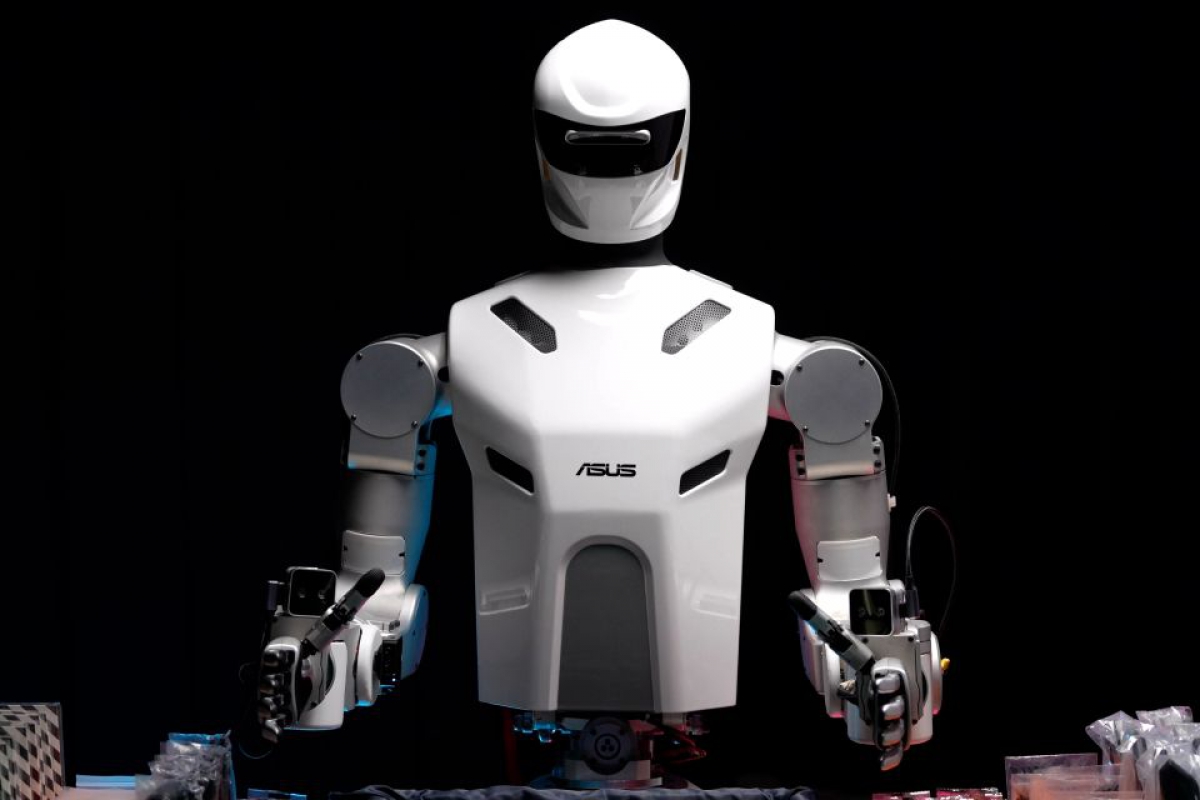
ASUS details how it learns Gallop, its first humanoid, and plans to market it in the second half of 2028
ASUS has published new details about Gallop, its first humanoid robot, which is learning to package motherboard accessories in a group factory. The stand brings together fifteen different pieces, many small and kept in transparent bags, and is used to check how the robot responds to a production task.
The company has also finalized its calendar: it is preparing a demonstration for customers at Computex 2027, pilots during that year and commercial availability in the second half of 2028. These are planned dates for a project that is still in development.
Fifteen pieces and a twenty second goal
The chosen job requires manipulating objects of different shapes and consistency. Thin bags add a difficulty: the robot must hold flexible materials, in addition to recognizing and placing each accessory.
ASUS aims to complete the cycle in twenty seconds with 99.5% success. The figure describes the level you intend to achieve. The manufacturer has not yet published a current result that allows us to verify how close Gallop is to that goal.
A cycle of twenty seconds would be equivalent, through a theoretical calculation without stops, to 180 cycles per hour. That account does not represent the measured productivity of the robot: the results of continued operation and the time spent resolving incidents are missing.
The format responds to the use of positions already designed for people. ASUS wants the arms to work with existing tools and trays, reducing the necessary modifications to the station. For now, the described task is limited to picking up and placing accessories.
Learn by observing workers and through teleoperation
Albert Chang explains that ASUS starts from open models and records the work of experienced operators using head cameras, with their consent. The simulation introduces variations on these demonstrations.
Then, an operator with a virtual reality headset and gloves guides the robot over the same pieces and with the cameras in the real position. Records obtained during work return to training.
The software separates planning, supervision, skills and control. These layers communicate through fixed interfaces, allowing models to be replaced without redesigning the robot.
The planner interprets the scene and divides the work into steps. A second AI monitors the execution and can rethink it if it detects a problem. The skills layer manages actions such as reaching, holding, and placing; The control is responsible for physical movement and stopping it in the event of an incident.
A fixed base before adding wheels
The current configuration uses two arms on a fixed base and a NVIDIA Jetson AGX Thor. The brand develops the body and its own hands with tactile perception, which it plans to integrate together with mobility on wheels.
As a platform reference, NVIDIA’s Jetson AGX Thor development kit combines a Blackwell GPU with a fourteen-core Arm Neoverse-V3AE CPU and 128 GB of LPDDR5X memory. NVIDIA announces up to 2,070 TFLOPS in FP4 with sparse arrays and configurable power from 40 to 130 W.
These figures correspond to the NVIDIA team. ASUS does not specify in its explanation the power limit that Gallop applies nor does it publish consumption measurements of the entire robot. Nor does it allow the theoretical performance of AI to be converted into a manipulation speed: the latter depends on the physical execution of the task and is verified with the cycle time and the successes.
NVIDIA accompanies the hardware with JetPack, its software suite to develop and deploy AI applications on these devices. ASUS indicates that it uses standard robotics software, although it does not identify the specific open models of each layer.
The packing station is the advertised validation environment. The first external pilots are planned for 2027; ASUS has not yet communicated a price for the projected marketing in 2028.
