
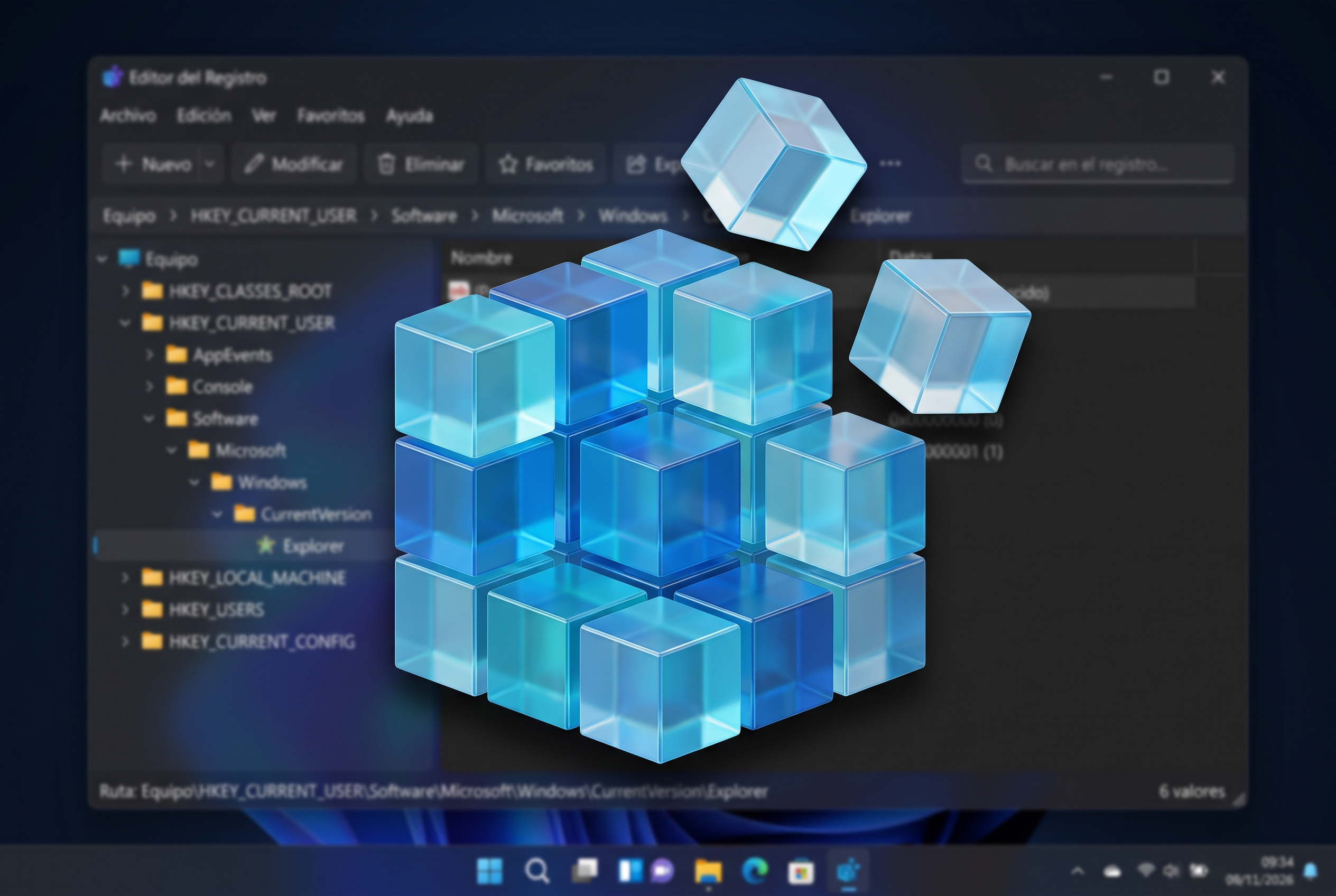
Microsoft has a Registry Editor made with WinUI 3 that already works on Windows 11
The Windows Registry Editor retains almost the same face as it had in Windows 95. In three decades, the only visible novelty was the address bar that arrived with the Windows 10 Creators Update. Now, Microsoft already has a version built with WinUI 3 which works and reads the actual system log.
As verified Windows Latestthe tool is part of Microsoft.UI.Reactor, an open source repository from the company. The medium has compiled it and run it on a PC with Windows 11 (Build 26340.9882), where opens as fast as the original regedit. Of course, it is a sample for developers and the company has not announced that it will replace the current editor. At least for the moment.
A new design that does not contribute much to usability
It must be made clear that, as some criticisms launched in X warn, this new version does not contribute absolutely anything, beyond the new design. And the WinUI version maintains the classic distribution, with the keys on the left and the values on the right.
In fact, it is possible that for many it is a worse proposal than the original. For example, the menus have more space and the tree does away with the yellow folders. Seen from a usability point of view, these are steps backwards rather than tangible improvements. Of course, there is now a lower status bar that shows the route you are on.
The good news is that everything is native. There is no HTML, Electron or WebView2, because every menu and every dialog is a native WinUI control. Additionally, a separate class manages reading and writing of the registry and captures permission errors so that a protected key does not kill the application.
It is worth remembering that Microsoft has been porting old parts of Windows 11 to WinUI 3 for months, such as the Properties dialog, Print Management or the Run box. It is also working to lighten WinUI 3. All this fits with the K2 project, the internal plan with which it wants a faster and more stable system before 2027.
