
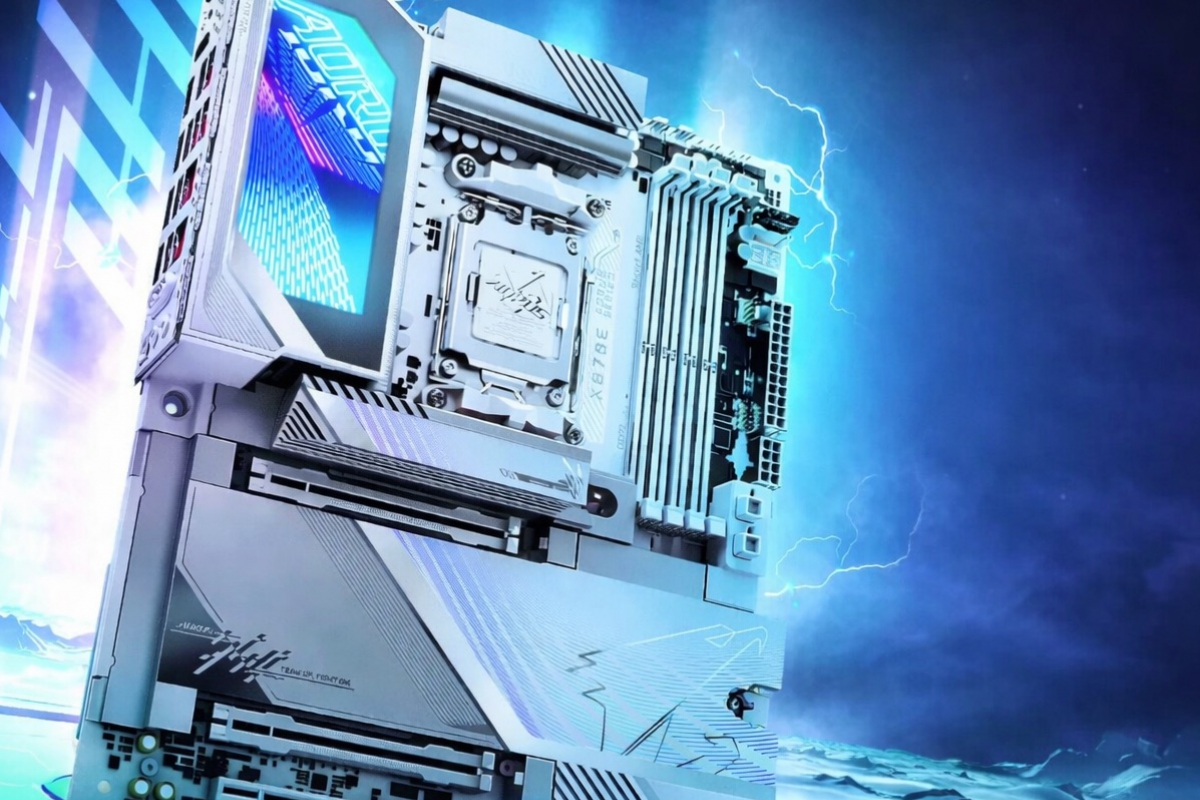
GIGABYTE updates its AM5 boards with a BIOS designed for the new Ryzen 9 9950X3D2
GIGABYTE has announced a new BIOS for its AM5 motherboards with AMD 800 and 600 series chipsetan update that comes with a very specific objective: to provide full support and adjust performance for the Ryzen 9 9950X3D2. The novelty revolves around AGESA 1.3.0.0abut the important thing is not just the version, but the underlying message: the AM5 platform is already preparing to receive one of the most peculiar processors that AMD has on the way within Zen 5.
According to what was communicated by the company, this BIOS is not limited to the basic boot of the processor, but incorporates full support and specific optimization for your cache architecture. The Ryzen 9 9950X3D2 is described as a Dual edition with L3 stacked in a configuration that doubles the cache available under the cores, a proposal aimed at improving latency-sensitive loads and intensive data movement scenarios. It would not, therefore, be another high-end Ryzen, but rather a model designed to take advantage of a particularly aggressive cache structure.
An update that arrives before the commercial release
One of the most interesting points of the announcement is the timing. GIGABYTE claims that it already introduced AGESA 1.2.8.0 into production in mid-January, allowing AM5 800 and 600 series boards to boot with the 9950X3D2 before its official launch. Now, with AGESA 1.3.0.0a, the brand is already talking about a fully optimized experience. In addition, it places a specific date on the table: the Ryzen 9 9950X3D2 would go on sale on April 22, 2026.
This calendar fits with the previous references that had been appearing. In recent weeks, traces of the processor had already been seen in performance tests and in partner documentation, which reinforced the idea that the chip was still alive, even if it had not yet featured in a traditional public announcement. In one of those appearances there was talk of 16 cores and 32 threads, 4.3 GHz base, up to 5.6 GHz peak, 192 MB of total L3 cache and a TDP of 200 W.
The BIOS is no longer just compatibility
The other big leg of the ad is optimization. GIGABYTE accompanies this BIOS with support for X3D Turbo Mode 2a proprietary feature that, according to the brand, uses an integrated AI model to dynamically optimize multitasking and gaming performance. The idea is to manage background processes and thread affinity to prioritize the active task and make better use of the 9950X3D2’s huge available cache.
Beyond the usual marketing, the move reveals something interesting: board manufacturers are no longer content with offering basic compatibility, but are trying to build adjustment layers around x3d renderers. In chips where the layout of the cache and the behavior of the scheduler can make real differences, the BIOS once again gains prominence as a tuning tool and not only as a requirement to boot the system.
Furthermore, the fact that GIGABYTE places X3D Turbo Mode 2 within the BIOS interface itself reinforces this idea of direct access to profiles designed for a specific processor. The company sells it as a one-click optimization, something designed to simplify an area that normally requires more manual touches.
A different Ryzen within the Ryzen 9000 family
Everything indicates that the Ryzen 9 9950X3D2 will occupy a very unique space within Granite Ridge. Compared to the conventional Ryzen 9 9950X3D, associated with 128 MB of L3 cache and 170 W, this Dual variant would go further with 192 MB and 200 W, maintaining a somewhat more conservative frequency ceiling. That balance suggests that the goal is not just to push raw numbers, but to especially push loads where cache makes a difference.
That reading also helps understand why manufacturers are moving ahead of commercial launch. On an already mature platform like AM5, preparing early compatibility is almost a way of sending a message to the market: whoever already has a compatible board can stay very close to mounting the new processor without changing half the system.
The platform is ahead of the processor
GIGABYTE’s announcement is relevant because of the chip, yes, but also because of what says of the platform strategy. AM5 continues to gain mileage and manufacturers want that longevity to translate into real updates, not just promises. Being able to say that the same base covers different generations with a simple BIOS update is an important commercial advantage.
In that context, the new GIGABYTE BIOS is not a simple technical note. It is one more piece in the landing of the Ryzen 9 9950X3D2. And although its final figures have yet to be seen outside of leaks and preliminary announcements, the message that this movement leaves is quite clear: the AM5 ecosystem is already positioning itself to receive one of the most striking and ambitious Ryzen of the Zen 5 generation.
