
https://www.geeknetic.es/Noticia/37284/Cada-puerto-HDMI-trabajo-costar-alrededor-de-1-dolar-en-una-GPU-y-gran-parte-no-es-hardware-sino-licencias-y-certificacion.html
When we think about what makes a graphics card more expensive, we almost always look at the silicon, the memory or the heatsink. But there is a part of the design that seems secondary and yet adds up to more than many people believe: the video ports. Specifically, HDMI.
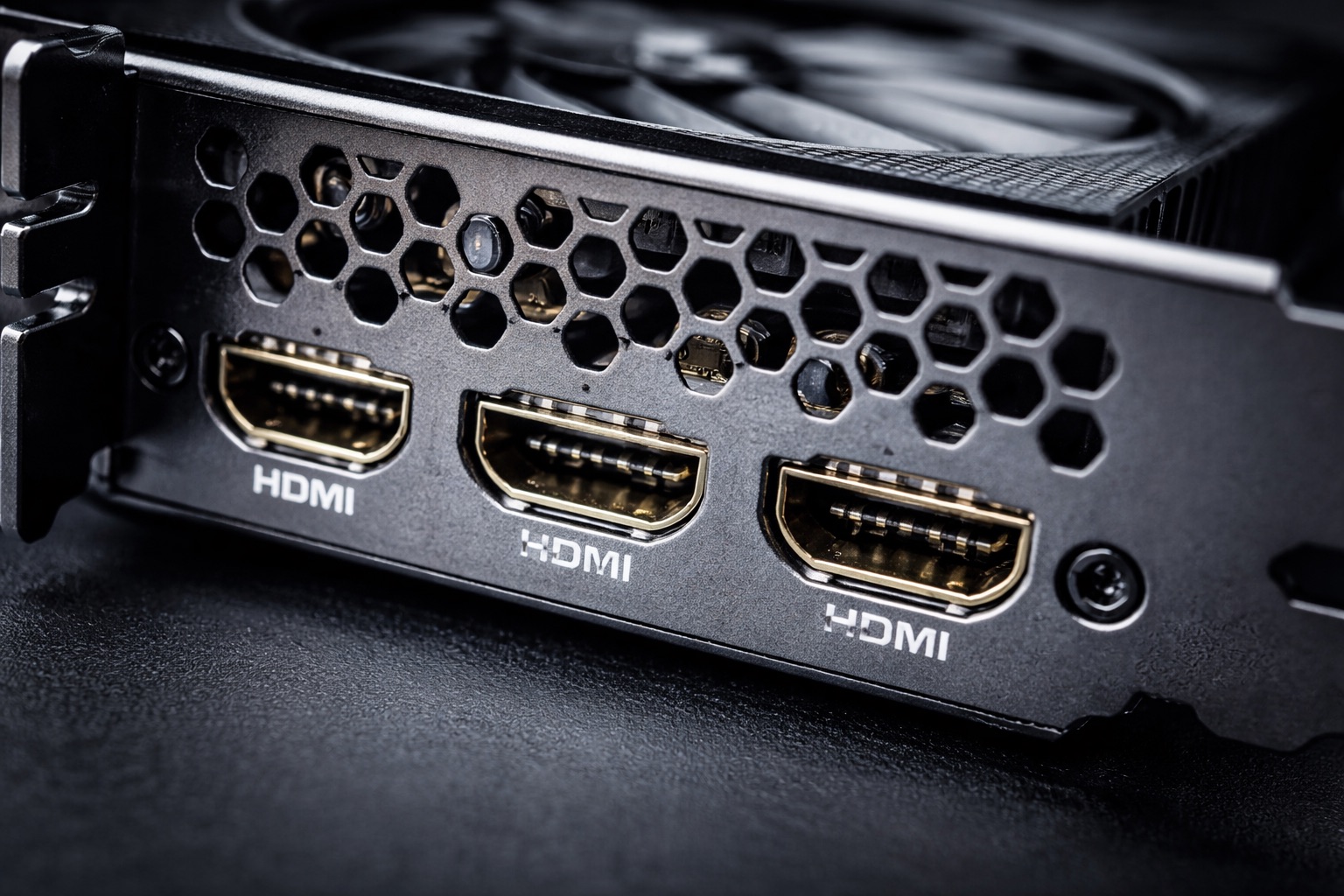
These days the topic has been talked about again due to a figure that sounds small, but that, on an industrial scale, has weight: that each HDMI port can cost around 1 dollar and that a large part of that cost would not be the metal of the connector, but what is around it, especially licenses, certifications and associated requirements.
The idea is not new, but it is a good reminder of why some brands tighten the number of outputs so much and why, in entry-level ranges, you sometimes see combinations that seem strange.
The real “price” of an HDMI port is not just the connector
A physical HDMI connector, as a piece, It is not an expensive component in itself. In volume, the cost of metal, plastic and manufacturing is usually relatively contained. The problem is that the port does not live alone.
For an HDMI output to really work on a GPU, you need more things around it:
- ESD protection to prevent an electrostatic discharge from bursting the line.
- Signal and integrity controlbecause at high data rates every detail of the PCB matters.
- Associated components to filtering and, in some designs, retimers or elements to keep the signal stable.
- Compatibility testsbecause HDMI cannot afford “more or less works”. If it fails with a specific TV, support becomes hell.
And to that is added the element that raises the most blisters: the licensing ecosystem and standard adoption.
HDMI: adoption, licensing and the fine print you pay
HDMI environment itself is clear to one point: To license recent specifications you need to be an “Adopter” and sign the corresponding agreements. That means that, at a business level, it’s not just “I put the port in and go,” but there is a formal framework around it.
Additionally, various summaries of the cost schedule explain that there are annual fees as well as per-unit fees. An example widely cited in the sector is the breakdown collected by Symmetry Electronics: for High volume manufacturers mention an agreement with $10,000 per year, and for low volume $5,000 per year plus a flat rate of $1 per unit within that low volume program.
Be careful with the nuance: That $1 flat rate is described as per unit of product in the low-volume agreement, not literally “per port.” Even so, it helps to understand where the round figure that circulates comes from when someone simplifies it when talking about costs.
Why that figure becomes a conversation within GPUs
In graphics cards, every dollar matters more than it seems, especially in mid-range and entry-level cards. If a model competes on tight margins, adding several dollars on the starting block alone may force you to cut back elsewhere or adjust the RRP.
Furthermore, the cost is not distributed equally between manufacturers:
- A huge brand It amortizes quotas and processes better, because it distributes fixed costs among more units.
- a small brandor one that launches few units of a specific model, notices any fixed or semi-fixed cost much more.
That’s why the conversation about “how much does a port cost” frequently appears in companies that assemble cards. It’s not posturing, it’s pure accounting.
HDMI vs. DisplayPort: The Awkward Comparison
This is where the comparison that always comes in comes in: DisplayPort is usually presented as more “friendly” in licensing. Even recent informative summaries describe it as a standard royalty-free per devicecompared to HDMI with licensing and fee structure.
This doesn’t mean that DisplayPort is free in the practical sense. Implementing DP also has technical demands, validation and components. But it does change the type of cost: less “pay to use the name or framework,” more “pay for engineering and manufacturing.”
In real life, that’s why you see so many graphics cards with a typical mix: several DisplayPorts and one or two HDMIs. It is not only for compatibility with monitors and TVs, it is also a way to balance costs and avoid support problems.
There is also a point that is overlooked when we talk about licenses: the cost of failure. A problematic HDMI port is an RMA factory. And in hardware, a return is very expensive: logistics, diagnosis, replacement, reconditioning, customer service and reputation damage if the ball grows in networks.
What this means for the user: why your GPU doesn’t have “everything you want”
If you have ever wondered why a graphics card does not have three HDMIs “like a console”, or why in certain models there is only one HDMI and the rest are DisplayPort, this is an important part of the answer.
The other part is actual use: on PCs, most gaming monitors connect via DisplayPort. HDMI remains a wildcard port for TV, capture devices or a specific second monitor. So, for the manufacturer, it makes sense to put HDMI, but without making it the majority.
The “$1 for HDMI” figure works as a headline because it is easy to understand. But what is interesting is what it reveals: that the cost is not the rectangular metal hole, but the set of licenses, validation, protection components, PCB design and the risk of support.
