
Japan and NVIDIA will build a national AI infrastructure with 27,500 Rubin GPUs to boost robotics and industry
NVIDIA has announced an agreement with Japanese company Noetra to build a large national artificial intelligence infrastructure supported by Japan’s Ministry of Economy, Trade and Industry, known as METI. The project will be structured around 13,750 NVIDIA Vera CPU and 27,500 Rubin GPUwith the aim of providing computing capacity for robotics, manufacturing, logistics, healthcare, telecommunications and other industrial areas.
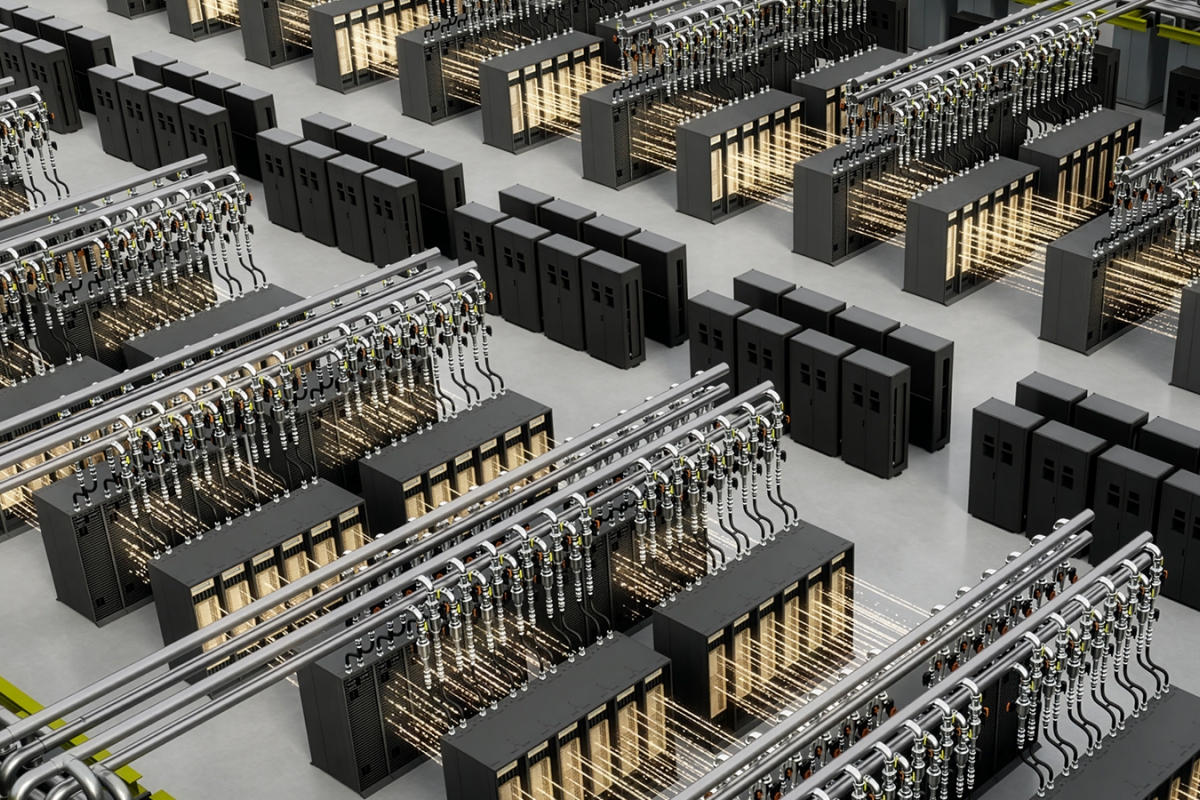
The installation will be deployed by Noetra and will use NVIDIA Vera Rubin NVL72 racks on the DSX platform, in addition to Spectrum-X Ethernet networks and BlueField DPUs. According to the company, the set will reach 140 megawatts of data center capacity and will be ready to scale the training of large artificial intelligence models.
NVIDIA presents this initiative as the first national artificial intelligence infrastructure aimed specifically at so-called physical AI. This concept encompasses systems capable of interacting with real environments through robots, agents, simulations and digital twins. The new AI factory will serve as the computing base of the FRONTia project, promoted by METI to develop multimodal foundational models applied to robotics and automation.
The infrastructure will combine Japanese industrial experience with large volumes of data from real environments. The objective is to train models capable of interpreting visual, textual and sensory information and then apply it to factories, logistics chains or robotic systems. NVIDIA notes that pre-trained weights of Noetra models will be widely offered to Japanese companies and developers.
Open models for agents, digital twins and robotics
Participants will also have access to NVIDIA tools and models such as Nemotron, Cosmos, Isaac GR00T, and NeMo libraries. The company hopes that this suite will facilitate the creation of artificial intelligence agents, simulation platforms and robotics applications. According to the advertisement, The priority will be to accelerate the industrial deployment of these systems within the Japanese market.
Jensen Huang, CEO of NVIDIA, has placed the project within the country’s industrial transformation. “Japan invented modern manufacturing. Now it is building the AI factories that will power the next industrial revolution,” he said. Huang added that NVIDIA is honored to collaborate on “the AI infrastructure that will power the country’s industries and economy.”
Japanese Minister of Economy, Trade and Industry Ryosei Akazawa explained that FRONTia will act as the core of the national physical AI ecosystem. “Through collaboration between Japan and leading global innovators, including NVIDIA, and leveraging the country’s strengths, we will build highly reliable multimodal foundational models,” he noted, with the aim of apply this technology to social and industrial problems.
For his part, Hironobu Tamba, CEO of Noetra, highlighted that bringing physical AI to real environments requires resources that a single company can hardly assume. “It requires enormous computing power, data and foundational technologies,” he said. The company intends to share research results to extend the use of models developed in Japan between public and private organizations.
Japan wants to gain weight in the global robotics market with AI
The project is integrated into the Japanese AI robotics strategy published in March. The country has set a goal of capturing more than 30% of the global AI robotics market by 2040, an opportunity that the Government estimates at around $133 billion. To move toward that goal, METI is funding multimodal modeling and industrial automation programs.
NVIDIA maintains that the DSX architecture will increase the number of tokens processed per megawatt and improve the reliability of the infrastructure. It also claims that the jointly designed combination of chips, networks and software will reduce operating costs for large-scale training. The installation will be prepared for models with billions of parametersaccording to the announced roadmap.
The company has not yet detailed the full construction schedule or the date when all capacity will be operational. However, the announcement defines the role of the facility within FRONTia. This would offer a common calculation base for Japanese companies and developers to train and deploy advanced systems. NVIDIA and Noetra thus propose a shared infrastructure to reinforce Japan’s technological autonomy in industrial artificial intelligence.
