
Los Alamos to use NVIDIA Vera CPUs in three new supercomputers to power scientific simulation and agentic artificial intelligence
Los Alamos National Laboratory (LANL) has detailed a new phase of its supercomputing roadmap with three systems that will focus on agentic artificial intelligence applied to science. NVIDIA has announced that future Mission, Vision and Veritas supercomputers, developed together with HPE, will use NVIDIA Vera CPUs within the Vera Rubin platform, combined with Rubin GPUs and Quantum-X800 InfiniBand networking.
The news also serves to highlight in a specific case the role that NVIDIA has been attributing to Vera within its new generation of infrastructure. We already saw at Computex 2026 that the Rubin platform had entered production, with Vera as a CPU designed for the era of agents. Now it seems that we are facing a real deployment in one of the most important laboratories in the United States for scientific simulation and national security.
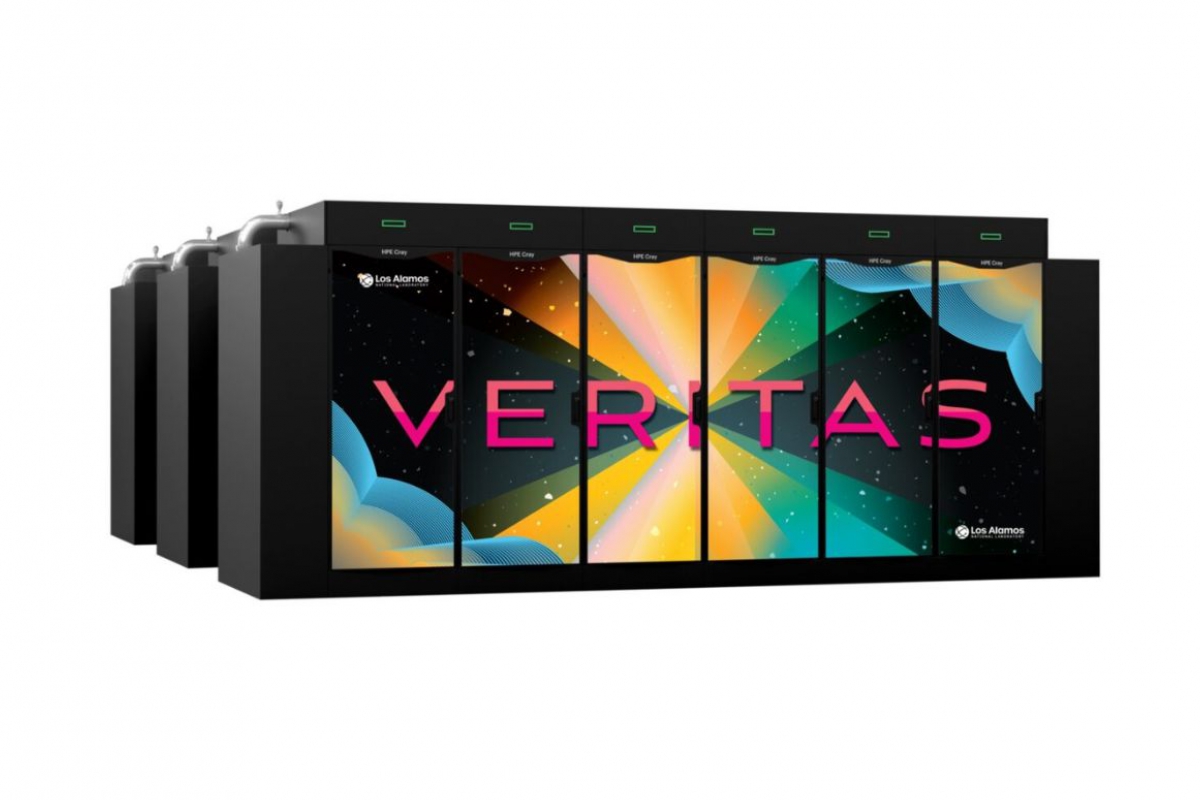
Depending on the planned configuration, Mission It will incorporate Vera Rubin nodes with GPUs, in addition to 2,300 independent Vera CPUs based on the HPE Cray Supercomputing GX240 platform. For its part, Veritas It will have about 1,150 autonomous Vera CPUs to complement the Vera Rubin nodes. Vision will arrive in parallel as part of the same infrastructure leap, although the statement dwells more on Veritas’ experimental and supportive role within the laboratory’s directed research program.
Vera gains prominence in loads of scientific agents and simulation
NVIDIA places Vera as a key piece for loads where accelerating models is not enough, but is necessary orchestrate tools, simulations and results analysis. This is where the idea of scientific agents capable of formulating hypotheses, choosing tools, launching simulations, interpreting outputs and deciding the next step fits in. LANL has already worked in this direction with URSA, its Universal Research and Scientific Agent, a modular framework aimed at supporting scientists in experimental planning, simulation and analysis.
In this context, the company assures that Vera has shown a notable advantage over the existing x86 infrastructure in the laboratory. In charges linked to URSA, NVIDIA claims that the new CPU offers up to seven times more performance than the processors used in Crossroads, the lab’s current x86 supercomputer. In early tests with Branson, an open Monte Carlo simulation tool for heat transfer, Vera also reportedly outperformed those same processors by more than three times.
NVIDIA’s explanation combines several architectural elements, namely its own Olympus core, LPDDR5 memory and a high-speed internal interconnect. The company claims that a single Vera CPU can outperform an x86 socket by more than three times, in addition to offering more than four times more memory per core and six times more memory per node. All this, according to the manufacturer, translates into faster scientific results and on a basis better adapted to the continued operation of specialized agents.
Mission and Vision will enter service in 2027 and will replace some of Crossroads’ current work
The planned calendar places Mission and Vision in 2027. Mission will be the fifth Advanced Technology System in the National Nuclear Security Administration’s ASC program and will replace Crossroads in national security classified payloads. Vision will target fundamental science, including materials, nuclear science, energy, biomedicine and artificial intelligence, with the idea of allowing more researchers to test methods and train models before moving payloads into more sensitive environments.
Veritas, meanwhile, will act as a platform for the lab’s internal research and development program and as a testbed for technologies that could later scale to larger systems. That role makes a lot of sense within the model that NVIDIA is promoting around Vera Rubin, where not everything revolves only around the large GPU rack. In fact, we had already reviewed at this year’s GTC how the different blocks of the platform were designed to distribute functions between computing, network, storage and agent execution.
Beyond the specific announcement, this collaboration shows quite clearly what NVIDIA is looking for with Vera. It is not just about accompanying Rubin with a new CPU, but about regain prominence for the CPU in flows where agentic AI needs memory, control, validation of results and classic simulation coexisting with advanced models. Los Alamos will be one of the first places where that idea goes from technical discourse to operational infrastructure.
