
LG will fill a 10,000 m2 facility with hundreds of robots to train its AI
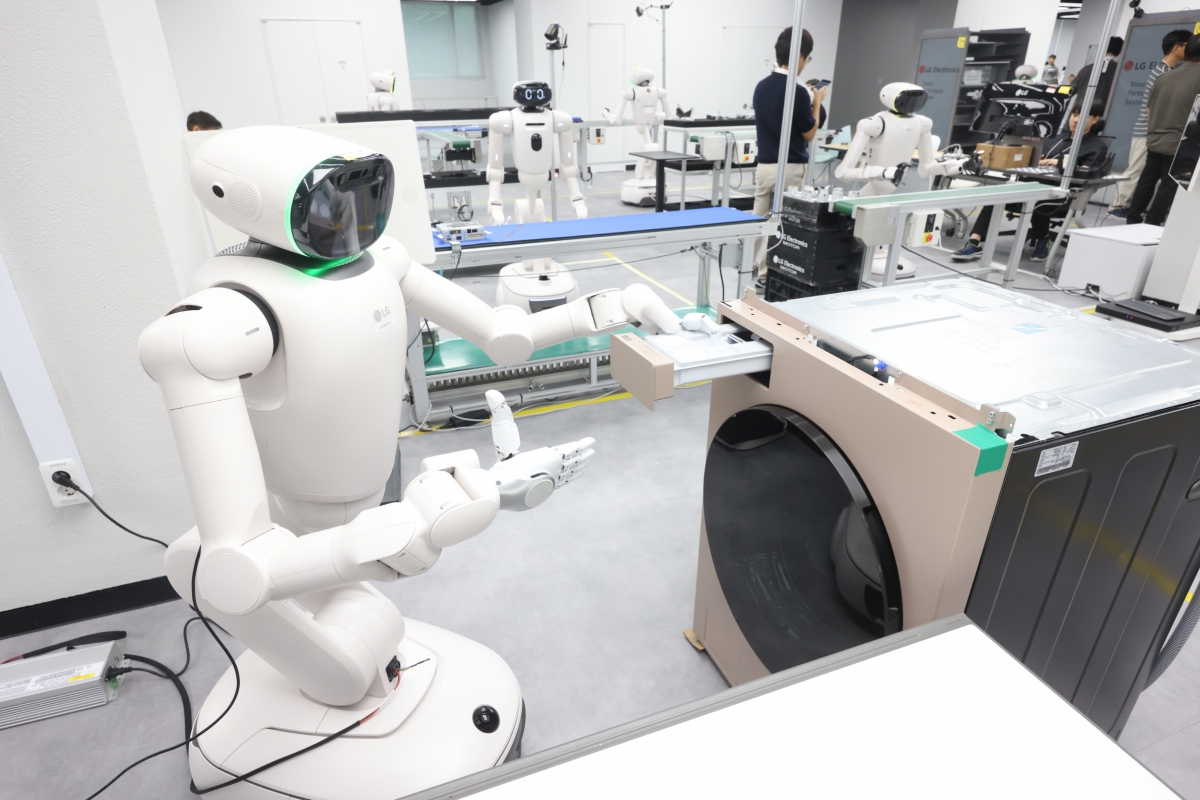
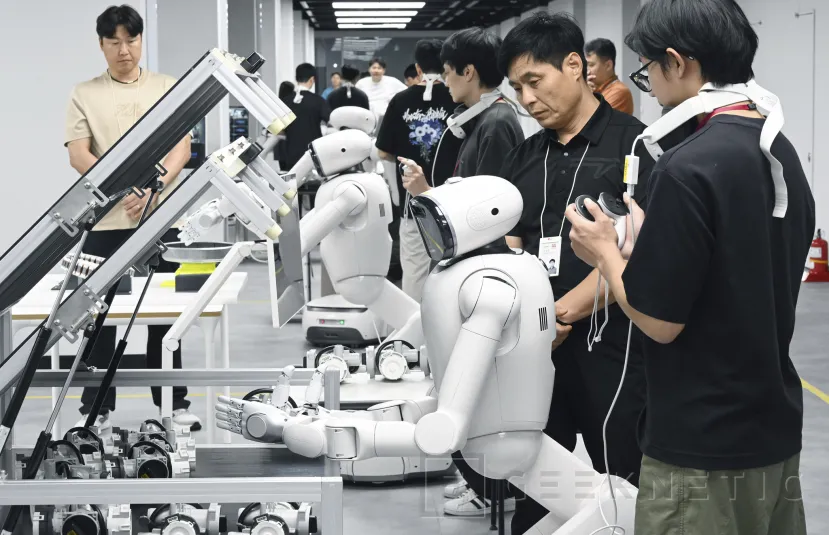
LG has detailed how the Data Factory will work which it is building at its Yangjae research and development campus in Seoul. The facility will be dedicated to generating, collecting, validating and expanding the data with which the company will train its next domestic, commercial and industrial robots. When fully operational at the end of 2026, it will house several hundred robots working simultaneously.
The project is part of LG’s collaboration with NVIDIA on physical artificial intelligence. Executives from both companies met at the facilities four days after signing their memorandum of understanding in Santa Clara.
A 10,000-square-meter facility to train robots
The Data Factory occupies four floorsone of them underground, and adds an area of 10,000 square meters. It combines areas where robots execute physical tasks with spaces intended for checking and purifying the data sets obtained.
The LG CLOiD home robots They are already used in the center to generate real data. One of the scenarios reproduces a home in which they practice and repeat cleaning tasks while their decisions and movements are recorded.
Another area imitates the washing machine plant that LG Electronics operates in Tennessee, United States. There, different CLOiD units learn to move, stack and assemble components. This replica connects domestic development with production processes where precision, repetition and safe handling are decisive.
Logistics and robotic hands expand training situations
The work is not limited to CLOiD demonstrations. LG will incorporate data from LG CNS logistics automation solutions and the space where LG Innotek develops and trains robotic hands. In this way, the group will bring together mobility, handling and coordination operations collected in various businesses of the group.
LG’s accumulated experience in manufacturing and logistics will also be integrated into the system. The Data Factory will act as a central point to organize and expand this material before using it in new training.
LG calls data flywheel to this continuous process. Each robot produces information as it works; the results are analyzed and enriched; the updated set is again used to train the system. Subsequent tests generate higher quality data and allow the cycle to be repeated. The ability to maintain this flow will be one of the centerpieces of the company’s robotics strategy.
NVIDIA Cosmos will turn real data into more scenarios
The NVIDIA platform It will be used from data preparation to deployment. LG cites the Omniverse librariesopen world models Cosmos and the development platform Isaac. These tools allow you to build simulated environments, generate synthetic variations, and prepare situations that would be difficult, expensive, or dangerous to physically reproduce thousands of times.
Logs captured by the robots will be combined with information created and expanded using Cosmos. LG’s goal is reach 100,000 hours of training data by the end of 2026a volume equivalent to about twelve years of consecutive activity. The figure adds up physically collected experiences and synthetic content produced with NVIDIA tools.
This combination allows you to change lighting, layout and objects within a simulation, as well as reproducing rare cases. LG will validate the synthetic data in the control and refinement areas of the center.
Data will feed LG’s founding model
The planned 100,000 hours will be used to develop the LG Robot Foundation Model. This model will provide common capabilities to future humanoid robots, which can then be adapted to specific products and jobs.
LG wants to take advantage of components that it already develops within the group. The company has experience in motors and actuators; LG Innotek works with sensors and robotic hands, while LG CNS provides logistics automation systems. The Data Factory adds the layer dedicated to collecting and managing the information necessary to train the software.
The manufacturer has declared 2026 as the start year of its expansion in roboticsto. In July, it launched the Robotics Business Center, a division that reports directly to the CEO and brings together business development, sales and operations. Song Si-yongformerly linked to the LG Production Engineering Institute, heads this organization.
LG prepares its entry into domestic robotics
The company already operates in industrial and commercial robotics through its internal capabilities, Robostar and Bear Robotics. Your next area will be the home, where CLOiD serves as an experimentation platform.
Lyu Jae-cheol, CEO of LG Electronics, assures that coordination between the group’s subsidiaries and its technological alliances will support this expansion. The collaboration with NVIDIA provides simulation and learning tools, while LG incorporates real environments, components and manufacturing knowledge.
The Yangjae Data Factory should be fully operational before the end of 2026. By then, LG expects to have several hundred robots across its four plants and complete the combined 100,000 hours of real and synthetic training that will be used to develop its Robot Foundation Model.
