
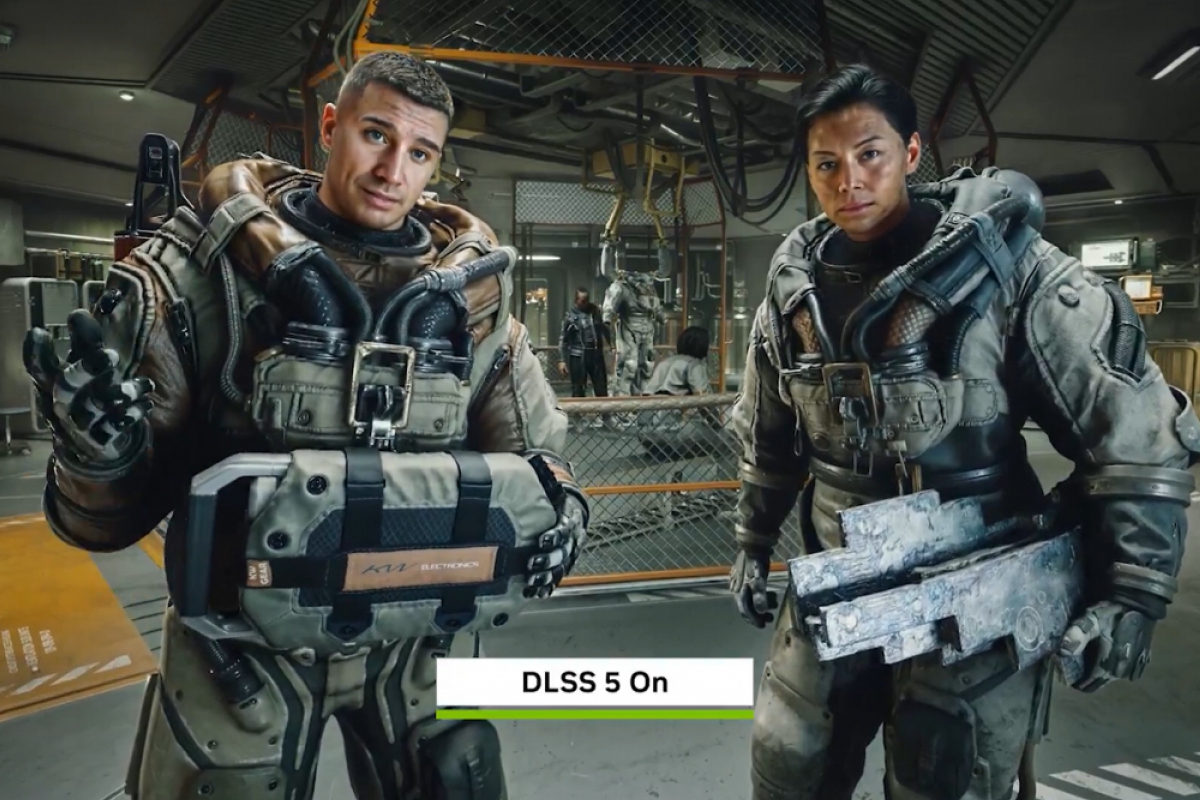
NVIDIA confirms that DLSS 5 will reach the RTX 40 after quintupling the performance of its neural rendering model
If anyone was worried about having to change graphics to enjoy DLSS 5, now they can breathe a little easier. The company has confirmed to the specialized portal Wccftech that its new neural rendering technology will end up landing on the RTX 40 based on the Ada Lovelace architecture. Of course, the deployment for the previous generation will arrive in a staggered manner, once they have finished polishing and squeezing Blackwell to the maximum.
DLSS 5 running on a single graph
What’s the point of so much waiting? Well basically because this algorithm It is a real devourer of resources. In fact, internally they have classified it as the heaviest software development that the company has released so far. Remember that in the first technical demonstrations this spring, DLSS 5 was so demanding that it required two RTX 5090s working in parallel to work. Months later, and based on optimizing the code and fine-tuning the processing cores, NVIDIA claims to have multiplied the initial performance of the model by five.
The official debut is scheduled for this fall with NBA 2K27, which will become the definitive test for this new technology. Even so, NVIDIA’s roadmap contemplates continuing to release performance reviews in the coming months with the goal of leaving the frame rate penalty at an acceptable 10% or 15%. Getting that calculation load cut is a mandatory step if you want the RTX 40 to move inference smoothly without having to resort to patches such as multiple frame generation.
Pure neural rendering without altering the style of the game
Here we are no longer faced with the typical resolution rescaling or the simple insertion of invented frames in between. DLSS 5 takes a giant leap by entering the field of guided neural rendering in three dimensions. In other words, the AI model now touches directly on how global illumination, reflections on surfaces or the behavior of complex materials is calculated. In practice, the algorithm takes on heavy tasks that previously choked the game engine, working hand in hand with traditional ray tracing to gain a brutal level of detail without collapsing the classic rendering pipeline.
And in case you were wondering, that doesn’t mean that the AI is going to paint whatever it wants and destroy the aesthetics of the game. Given the doubts of the community, which even forced Huang to come out to explain himself, NVIDIA wanted to emphasize that the behavior of the network is completely deterministic. It is true that they have trained the models with images from the real world to recreate skin or hair textures with great realism, but technically the algorithm works tied short to the original frame that the graphics engine outputs.
In this way, it is the developers themselves who have the upper hand in deciding which elements receive neural processing, keeping the original artistic vision of the title intact. Now we know that all this deployment of technology It will also be available in lower rangesspecifically, the RTX 40, but it will be a long time before that is a reality.
