
OpenAI closes its Atlas browser and launches Work to turn ChatGPT into a work agent connected to the web and apps
In the last few hours, OpenAI has chained a veritable barrage of advertisementsfrom the expansion of GPT-5.6 with Sol, Terra and Luna to its preferential arrival in Microsoft 365. In addition to all that, the company has just presented ChatGPT Work, a new work layer within ChatGPT designed to turn the assistant into an agent capable of executing long tasks, connecting to business tools and generating finished results such as documents, spreadsheets, presentations or websites.
Likewise, OpenAI cancels the development of ChatGPT Atlas, its own browser, and instead reinforces a strategy more focused on artificial intelligence working directly with the web, applications and files from the ChatGPT desktop app. The decision fits with the line that had already been seen with the closure of Sora, where OpenAI already showed that it does not always want to maintain independent products if it can integrate its functions into a broader platform.
According to the company, ChatGPT Work can stay for hours within a single project, break it into smaller steps, gather information from different sources, and complete the work autonomously while the user monitors, answers questions, changes the direction of the process, or approves important actions. OpenAI presents it as an agent for ambitious tasks, not just a one-off query or writing tool.
ChatGPT Work connects to apps, plugins and files to create finished materials
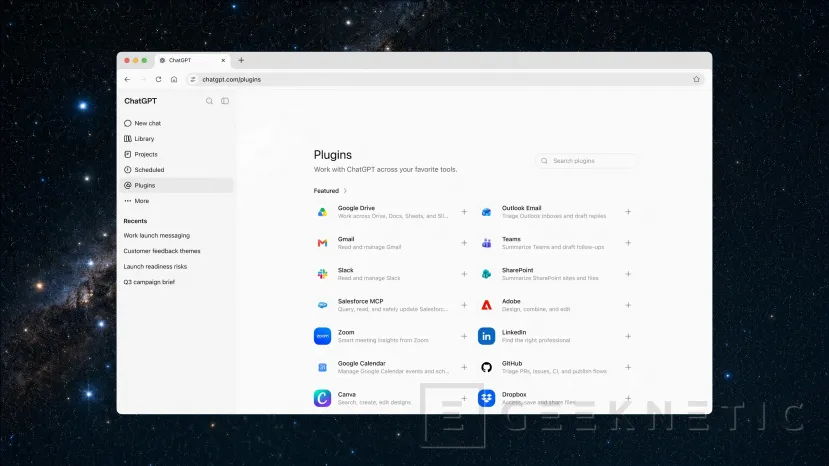
The proposal revolves around a very specific idea: that ChatGPT can access the place where the work already happens. To do this, OpenAI introduces a unified plugin directory with connections to tools like Slack, Microsoft Teams, Google Drive, SharePoint, email, calendars, CRM, project trackers, and other internal systems. Once connected, ChatGPT Work can use that information to write briefs, prepare analyses, update documents, redo presentations, or create new materials with the appropriate context.
OpenAI explains that the agent is powered by GPT-5.6the same model that the company is progressively deploying in other products. That model would be in charge of reasoning about multi-step tasks, following templates and reference files, and maintaining the thread between different phases of the same workflow. In practice, the company wants ChatGPT to be able to turn a broad request—for example, preparing a sales meeting or analyzing a financial close—into a sequence of coordinated actions and deliverable results.
Another important point is continuity between devices. OpenAI notes that ChatGPT Work will work on web, mobile and desktopso a task can be started from the phone, reviewed from the desktop app, and continue moving forward autonomously with Scheduled Tasks. This would allow, for example, to transform new Teams or Slack messages into updated documents or a revised presentation without constant user intervention.
OpenAI absorbs Codex and leaves the browser as a function, not a product
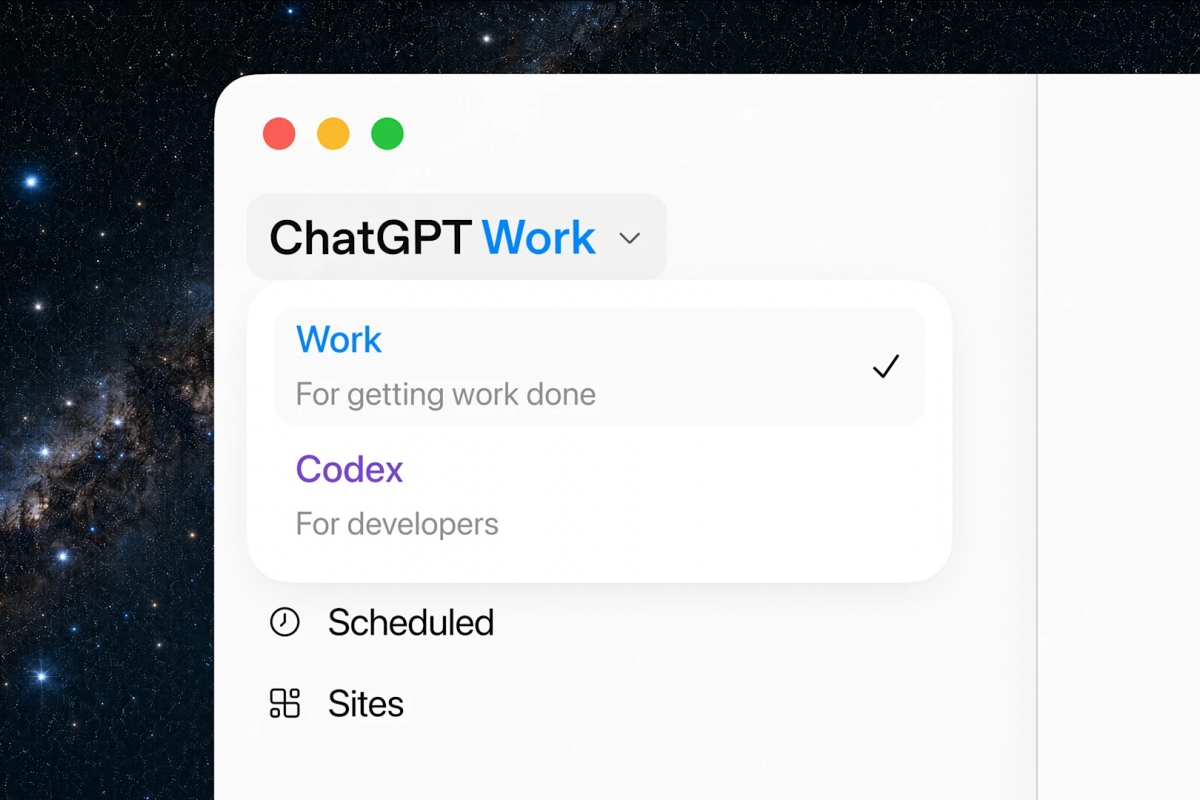
In parallel, OpenAI confirms that the Codex app is merged with the new ChatGPT desktop app. Codex remains a scheduling agent, but now within a broader experience that combines Chat, Work, Codex, scheduled tasks and Sites. The company also adds an integrated browser for web work, reinforcing the idea that it no longer needs a separate browser to fulfill that function.
This makes sense, especially if we think that maintaining our own Chromium-based browser required supporting an additional product with its own identity, updates, and journey. With ChatGPT Work, OpenAI seems to opt for bring web navigation and automation within the agentrather than defending Atlas as a separate piece. The result is a bet that is more coherent with its main platform: fewer satellite applications and more unified functions around ChatGPT.
Due to availability, ChatGPT Work begins to be deployed on web and mobile for Pro, Enterprise and Edu. It will arrive later in Plus and Business, and the ChatGPT desktop app with Chat, Work and Codex will be available on Windows and Mac on all plans, including Free.
