
Razer renews the Blade 18 with Intel Core Ultra 9, dual screen and configurations that are close to $7,000
Razer has presented the new generation of the Razer Blade 18a large-format laptop that reinforces the idea of replacing the desktop in a single computer. The company presents it as a machine designed both for AAA games and for workloads linked to artificial intelligence, software development, code compilation and rendering, all with high-end hardware and a design that maintains the usual premium line of the Blade family.
The announcement revolves around a configuration that combines the processor Intel Core Ultra 9 290HX Plus (can also be purchased with the Intel Core Ultra 9 275HX) with graphics options that go up to the NVIDIA GeForce RTX 5090 Laptop with 175 W TGP and 24 GB of VRAM. According to the company, this suite allows you to run local inference with language models, create content with generative AI and maintain high performance in demanding games without completely depending on the cloud.
Razer also insists that this Blade 18 is not limited to an eye-catching technical sheet, but seeks to offer sustained performance over long sessions. To do this, it uses an advanced vapor chamber with a system of several fans, a necessary solution in an 18-inch laptop that wants to approach the behavior of a desktop computer in intensive tasks.
Specifications of the new Razer Blade 18
| Specification | Razer Blade 18 |
|---|---|
| Processor | Intel Core Ultra 9 290HX Plus 24 cores Up to 5.5 GHz NPU up to 13 TOPS. Also available with the Intel Core Ultra 9 275HX |
| Graph | Up to NVIDIA GeForce RTX 5090 Laptop, 175W TGP, 24GB VRAM |
| Screen | 18-inch Dual-Mode with UHD+ at 240 Hz or FHD+ at 440 Hz |
| Color coverage | Up to 100% DCI-P3 space |
| Glow | Up to 20% more than the previous generation, according to Razer |
| RAM memory | Variable configurations depending on model, not detailed in the information provided |
| Storage | Variable configurations depending on model, not detailed in the information provided |
| Connectivity | Thunderbolt 5, WiFi 7, HDMI 2.1, 2.5 Gb Ethernet, UHS-II SD reader, USB-C with up to 100 W charging |
| Audio | 6-speaker system with THX Spatial Audio+ |
| Camera | 5MP IR Webcam with Windows Hello and Privacy Shutter |
| Chassis | Aluminum machined from a single block |
| Price | From $3,499 |
The keys to the new Blade 18 are local AI, the dual screen and an extreme configuration
One of the most striking elements of the new model is its dual screenwhich allows you to switch between UHD+ resolution at 240 Hz and FHD+ at 440 Hz. On paper, this proposal attempts to cover two very different uses, on the one hand content creation, editing or development with more definition and, on the other hand, competitive gaming with a much higher refresh rate.
Connectivity also points to this approach as a substitute for the desktop. The laptop integrates Thunderbolt 5, WiFi 7 and 2.5 Gb Ethernetin addition to HDMI 2.1, UHS-II card reader and USB-C charging of up to 100 W. Added to this is a 5 MP IR webcam with Windows Hello compatibility and a six-speaker system with new THX Spatial Audio+ architecture.
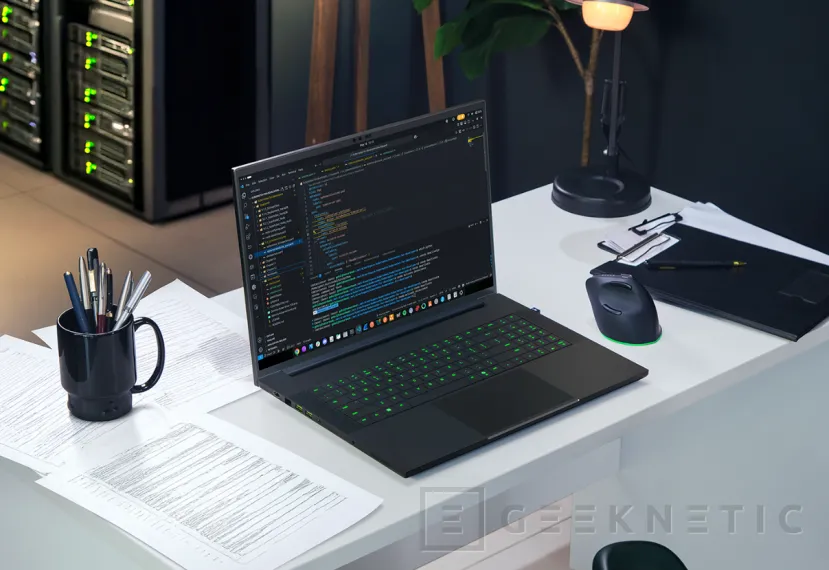
Razer places this Blade 18 in a field that goes beyond the traditional gaming laptop. The company talks about Up to 37% faster LLM inferences and image generation with AI up to 2.2 times faster compared to other comparable laptops, figures that it uses to reinforce its team discourse valid both for playing and for working with local models and hybrid flows between cloud and local execution.
This positioning fits with an increasingly visible trend in high-end laptops, where the battle is no longer fought only in FPS or design, but also in how much they can take on AI loads without leaving your own team. The presence of a dedicated NPU and a GPU with up to 24 GB of VRAM points precisely to that goal, that is, executing more tasks locally with less latency and greater control over data.

However, the fact that best summarizes the audience this launch is aimed at is its price. Razer clearly plays in the highest range of the market and, as stated, the Blade 18 can approach $7,000 if chosen with all available extensions. In any case, although it is not a laptop to compete by volume, but rather a proposal for those looking for the best features for different situations, the price is conditioned by the enormous component crisis in which we are immersed.
