
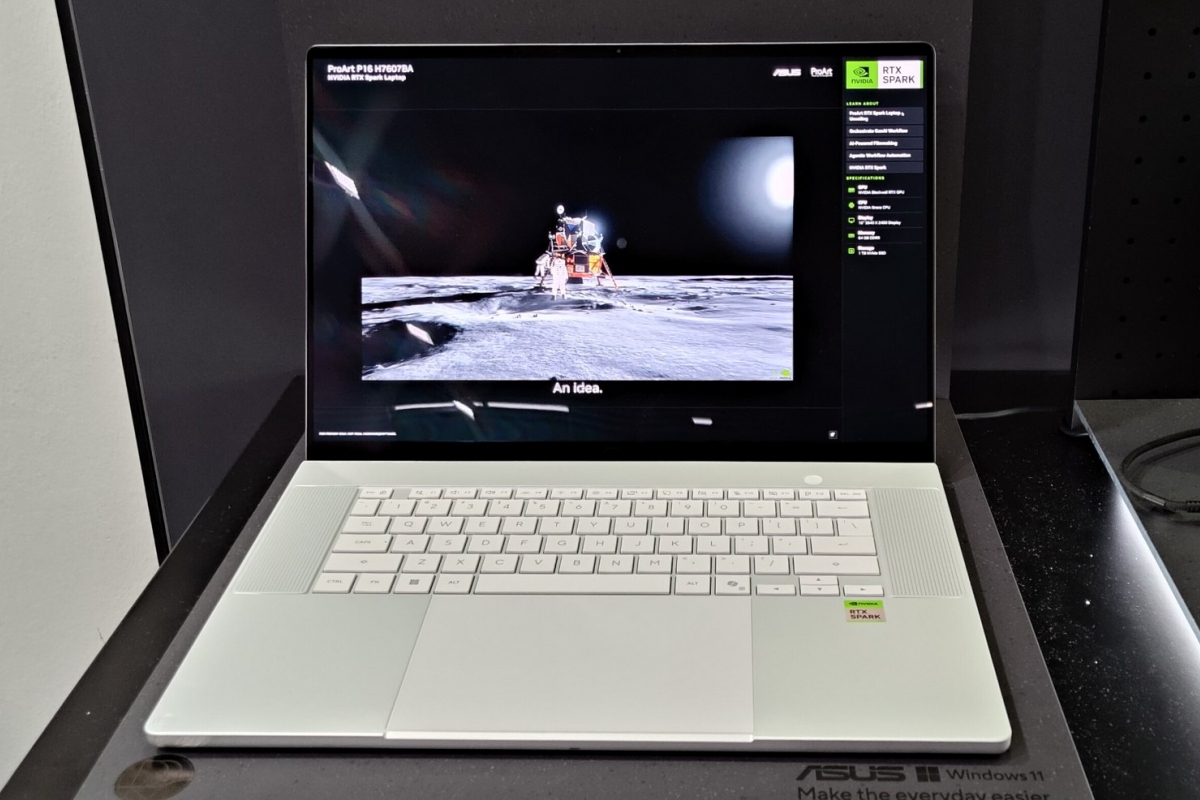
We have seen the ASUS ProArt P14 and P16 with RTX Spark at 80 W at IFA 2026
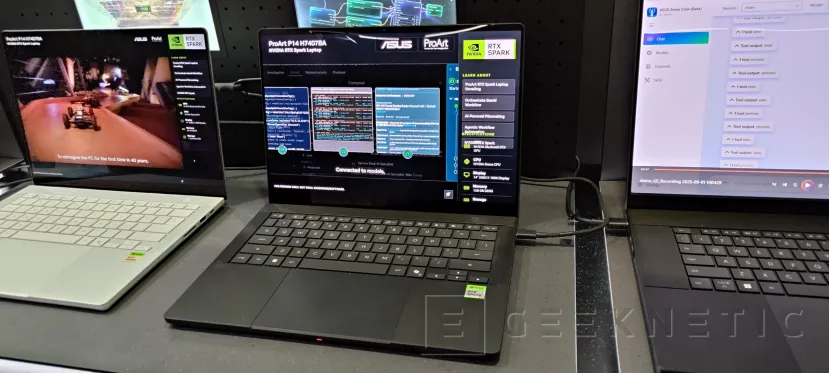
ASUS has brought its first ProArt laptops equipped with NVIDIA RTX Spark to IFA 2026. We have been able to see both the ProArt P14 like the ProArt P16two teams for creators and developers who transfer to 14 and 16 inches the new platform with Grace CPU, Blackwell graphics and unified memory.
During the presentation we learned a detail that allows us to better place its performance compared to desktop computers: RTX Spark works with a TDP of 80 W on both laptops. The ProArt GR1X, the mini PC presented alongside them, raises that margin to 140 W. The difference is important to understand how ASUS adapts the same superchip to computers with different thermal needs.
An 80W RTX Spark for both laptops
RTX Spark integrates a 20-core NVIDIA Grace CPU and a Blackwell RTX GPU with 6,144 CUDA cores. Both components share up to 128 GB of LPDDR5X memory via the NVLink-C2C interconnect. The platform achieves up to 1 PFLOP of performance on AI tasks with FP4 precision.
The 80 W corresponds to the margin available for RTX Spark within laptops. This is 60 W less than the 140 W of the GR1X, whose chassis has more space to cool the hardware during sustained loads. This difference in power does not allow us to establish an equivalence of performance on its own. Frequencies, thermal profiles and behavior under prolonged loads will have to be checked when we can test the equipment.
ASUS proposes these models to run local AI, render 3D scenes of more than 90 GB and generate video using artificial intelligence with 4K resolution. It also announces support for language models of up to 120 billion parameters, depending on the installed memory configuration.
Two sizes with OLED screens and different batteries
The ProArt P14 weighs 1.48 kg and measures 13.9 mm in its thinnest part. Integrate a 90 Wh battery and an ASUS Lumina Pro OLED touch screen 14 inches with up to 3K resolutionfrequency of 120 Hz and a maximum HDR brightness of 1,600 nits.
Its older brother increases the diagonal to 16 inches and offers OLED panels up to 4K and 120 Hzwith VRR and NVIDIA G-SYNC. The ProArt P16 weighs 1.77 kg, 12.9 mm thick part and equips a 99 Wh battery. ASUS offers the two models in Nano Black and Neo White finishes.
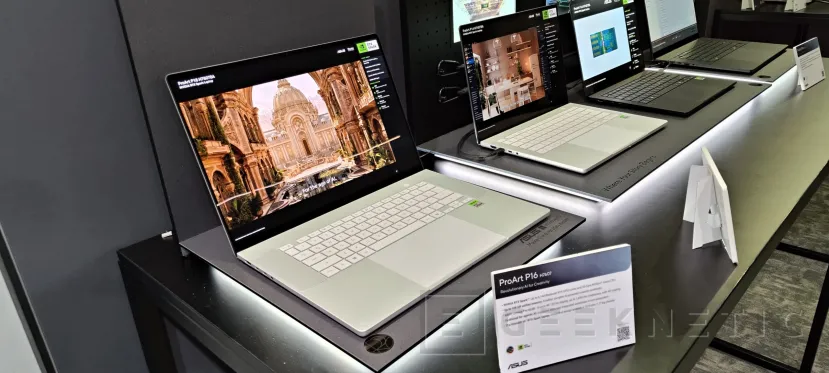
Common connectivity includes three USB4 with video output and charging, one 10Gbps USB-A, HDMI 2.1, SD card reader, WiFi 7 and Bluetooth 5.4. The P16 has two M.2 slots, while the P14 has one.
Local AI using ASUS and CUDA applications
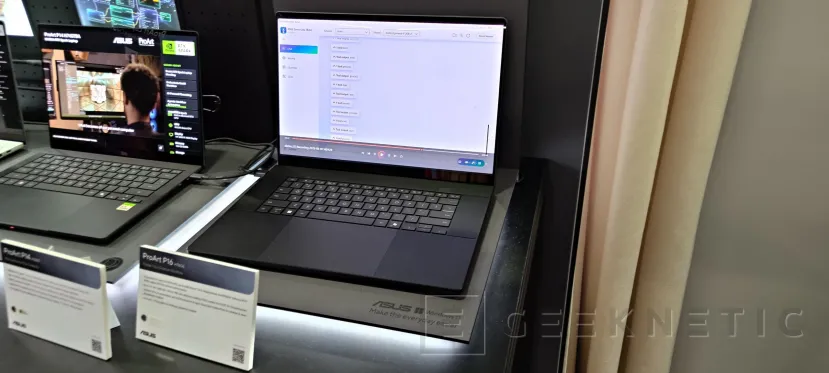
ASUS accompanies the hardware with MuseTreewhich integrates the models of FLUX and WAN imagingand StoryCubeintended to recognize scenes and organize multimedia files. The company has also shown flows based on ComfyUI and the interaction of Agent Zenni Claw with MuseTree.
Local processing allows you to keep files and requests within the computer, work offline and avoid the consumption of credits associated with certain cloud services. Compatible programs will be able to take advantage of the CUDA ecosystem and fifth-generation Tensor Cores.
ASUS has not yet communicated the prices of the ProArt P14 and P16. Its exhibition at IFA 2026 allows us to confirm, at least, that its portable configurations will limit RTX Spark to 80 W, compared to the 140 W available in the ProArt GR1X.
Specifications of the ASUS ASUS ProArt P14 and P16
| Specification | ASUS ProArt P14 H7407 | ASUS ProArt P16 H7607 |
|---|---|---|
| Platform | NVIDIA RTX Spark | NVIDIA RTX Spark |
| CPU | 20-core NVIDIA Grace | 20-core NVIDIA Grace |
| GPU | NVIDIA Blackwell RTX with 6,144 CUDA cores | NVIDIA Blackwell RTX with 6,144 CUDA cores |
| RTX Spark TDP | 80W | 80W |
| AI performance | Up to 1 PFLOP in FP4 | Up to 1 PFLOP in FP4 |
| Unified memory | 24, 32, 48, 64 or 128 GB LPDDR5X | 24, 32, 48, 64 or 128 GB LPDDR5X |
| Screen | 14 inches, OLED touch, 16:10 format | 16 inches, OLED touch, 16:10 format |
| Resolution | Up to 2,880 × 1,800 pixels (3K) | Up to 3,840 × 2,400 pixels (4K) |
| Refresh Rate | 120Hz | 120 Hz with VRR and NVIDIA G-SYNC |
| Glow | Up to 1,600 nits in HDR, depending on configuration | Up to 1,600 nits in HDR, depending on configuration |
| Color accuracy and coverage | Delta E less than 1 and 100% DCI-P3 | Delta E less than 1 and 100% DCI-P3 |
| Storage | 512GB or 1TB PCIe 4.0 SSD | 512GB, 1TB, or 2TB PCIe 4.0 SSD |
| M.2 slots | 1 M.2 2280 PCIe 4.0 x4 slot | 2 M.2 2280 PCIe 5.0 x4 slots |
| USB ports | 3 USB4 Type-C and 1 USB-A 10 Gbps | 3 USB4 Type-C and 1 USB-A 10 Gbps |
| Other connections | HDMI 2.1 FRL, 3.5mm audio and SD card reader | HDMI 2.1 FRL, 3.5mm audio and SD card reader |
| Wireless connectivity | WiFi 7 and Bluetooth 5.4 | WiFi 7 and Bluetooth 5.4 |
| Camera | Full HD with infrared and Windows Hello | Full HD with infrared and Windows Hello |
| Battery | 90 Wh, 4 cells | 99.9 Wh, 4 cells |
| Dimensions | 31.07 × 21.89 × 1.39-1.59cm | 35.41 × 24.30 × 1.29-1.59cm |
| Weight | 1.48kg | 1.77kg |
| Finishes | Nano Black and Neo White | Nano Black and Neo White |
| Operating system | Windows 11 Home or Windows 11 Pro | Windows 11 Home or Windows 11 Pro |
