
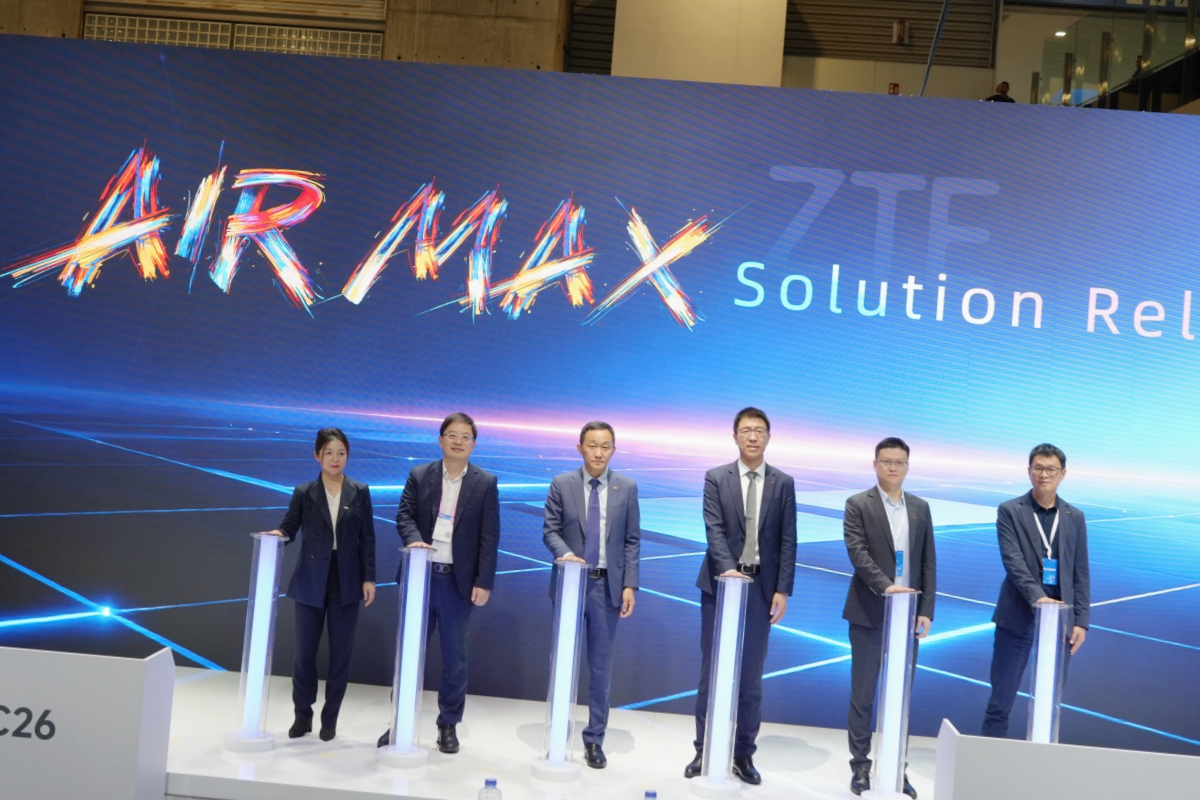
ZTE presents AIR MAX at MWC Barcelona 2026 to build the optimal mobile network for the AI era
ZTE has taken advantage of MWC Barcelona 2026 to announce AIR MAXa solution with which it wants to adapt the mobile network to a demand cycle marked by agents and terminals with artificial intelligence. The approach is based on three goals: maximizing energy efficiency, labor efficiency and investment efficiency, with the idea that the network evolves from traffic transportation towards a more active role in services linked to AI.
During the presentation, Zhang Wanchun, senior vice president of the companydescribed the moment as an accelerated transition towards a new paradigm that in the note is called Bit+Token, where the value is no longer only in moving data, but in enabling capabilities and services around AI.
AIR MAX: three levels and a change of focus
ZTE positions AIR MAX as the evolution of its 2025 AIR solution, with a pivot from network performance to business value. Tang Xue, Vice President of ZTE and Head of Computing and Wireless Product Strategy and Architecturesummarized the approach as serving AI with AI.
The architecture is organized in three layers– Native AI infrastructure, intelligent operations with Level 4 autonomy goal, and a monetization engine. The company indicates that it relies on a full-stack AI capability structured in ten modules to simultaneously drive technical architecture, operational efficiency and new business models.
Native AI infrastructure: energy savings, more useful spectrum and more throughput
At the infrastructure layer, ZTE talks about lightweight models and real-time deployment, with four notable capabilities.
The first is AI Radio, which integrates AI into wireless equipment. According to the company, techniques such as AI-based digital predistortion and related algorithms can cut power consumption by 35% to 40% compared to traditional power amplifiers. In addition, it attributes to AI a 20% spectral efficiency improvement through beam optimization and channel equalization in MIMO scenarios.
The second is a heterogeneous computing architecture that combines AI ASICs with xPU. ZTE highlights here its AIR Engine, which it claims to have deployed in more than 150,000 locations globally.
The third capability is GigaMIMO powered by AI. In its communication, ZTE associates it with a throughput of 192 Gbps and a six-fold improvement in the rate at the edge, with the aim of reinforcing the idea that AI can also increase useful capacity in the most demanding sections.
The fourth is ISAC, integration of sensing and communication. According to ZTE, its approach exceeds 95% accuracy in drone detection and supports high-precision sensing applications, a use case aimed at security and industrial operation environments.
Intelligent operations: level 4 autonomy and industrial agents in minutes
The second level aims at production and network operation. ZTE plans to move towards end-to-end autonomous intelligence, with level 4 ambition, using a 1+N matrix of low-speed models. The company estimates the accuracy of autonomous decisions at 92% and the factual consistency of outputs at 95%, and indicates deployment in 20 high-value scenarios.
In this layer they appear Co Sight 2.0described as an agent factory capable of generating reliable agents in minutes, and Co Claw, a digital employee aimed at coordinating several agents to close operational cycles with minimal human intervention. ZTE also cites evaluations from the TeleManagement Forum that places capabilities such as RAN power optimization and fault management at a leading level.
Monetization: experience services and Token services
The third layer is the monetization engine. ZTE proposes to monetize experience by combining first-class services with value-added packages per scenario, accelerating the transition from traffic-focused operations to experience-focused operations. In parallel, it proposes enabling Token services based on deterministic connectivity, low-latency distributed computing and massive data in real time.
The company adds an agent service system with eSIM-type authentication, on-demand subnet orchestration and collaborative computing between endpoint, edge and cloud, with the ambition of pushing operators from connectivity providers towards AI service providers and, finally, towards a secure ecosystem hub.
ZTE formalized the launch in Barcelona with the participation of those responsible for areas such as wireless strategy, core, RAN and data and intelligence products, and refers to demonstrations in its event space at Fira Gran Via, Hall 3. The company insists that AIR MAX is a step to integrate AI deeply into the mobile network, increasing operational efficiency and opening new avenues of value creation in a market where AI already conditions the way connectivity is consumed.
