
https://www.geeknetic.es/Noticia/37444/Thermaltake-TR300-una-caja-ATX-que-mueve-la-fuente-al-frontal-para-ganar-espacio-donde-mas-importa.html
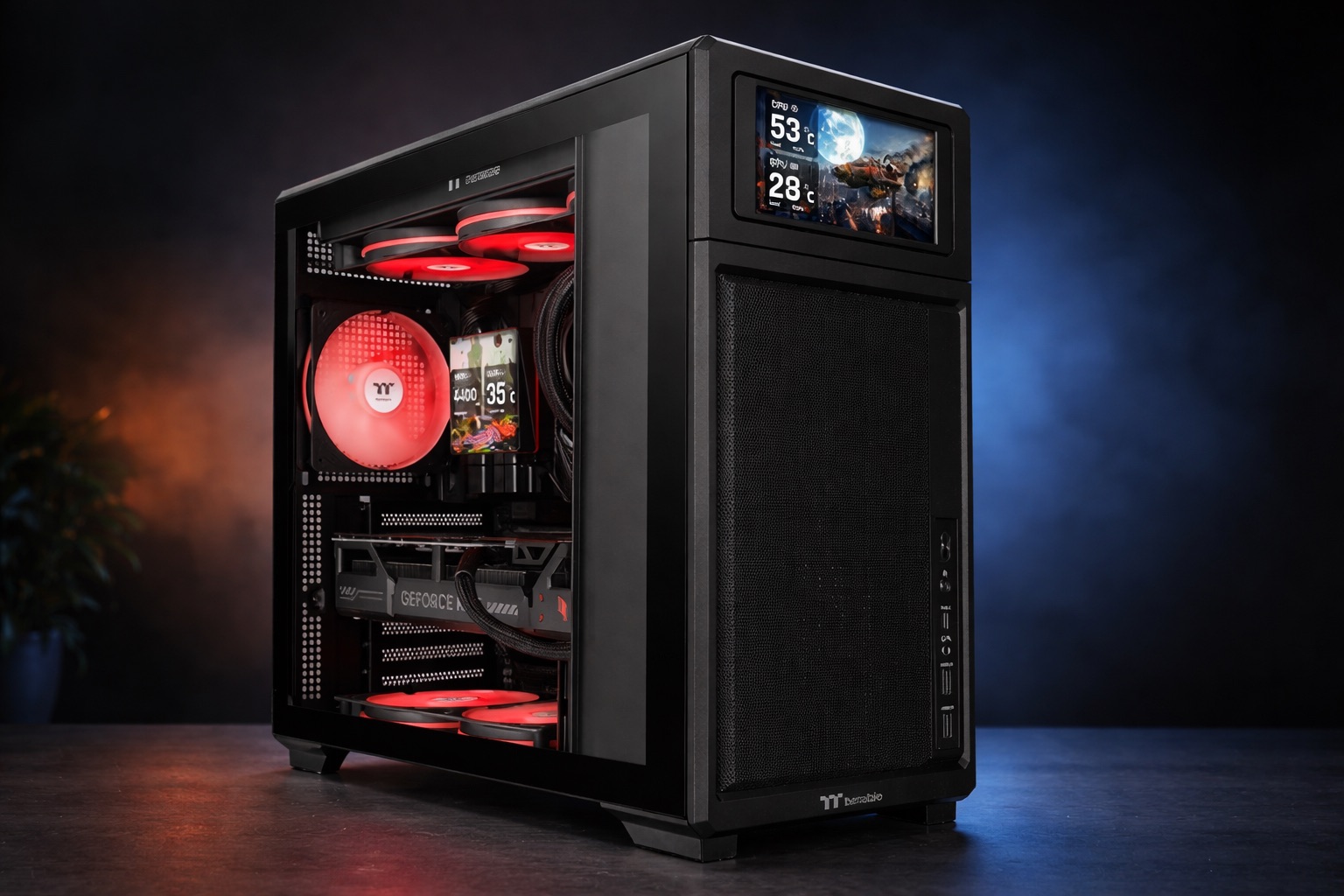
There is a problem that is repeated in many builds: you want a long graphics card, a large radiator and a clean interior, but the design of the box forces you to do Tetris with the source and cables. In this context it appears the new TR300an ATX mid-tower that departs from the usual pattern with a simple idea: bring the power supply to the front to gain margin where space is really fought for today.
At first glance it may sound strange, because for years the normal thing has been to hide the fountain at the bottom. But the goal here is clear: release critical areas to improve compatibility and, incidentally, give the user several possible configurations depending on the motherboard and the cooling system that is going to be installed.
Source on the front and four positions: the box adapts to the mounting
The TR300 allows install the font in four mounting pointsdesigned to adjust to the size of the motherboard and what you want to prioritize. The proposal itself summarizes it as a system of positions A, B, C and D: one focused on maximizing space for the graphics card, another to allow three fans at the top, another to make room for a 360 mm radiator at the top and a last one designed to improve the margin when thicker radiators and fans are mounted.
In practice, this has a very direct reading: you no longer assemble the box, you assemble your configuration. And if something doesn’t fit, you are not forced to change the chassis; You can rethink the position of the font to better fit the whole.
Cooling: up to eight fans and 360mm radiator on top
Thermaltake leans heavily on the thermal argument. The TR300 supports up to eight 120 mm fans and is prepared for AIO solutions of various sizes, with support up to 360 mm. Specifically, a 360mm radiator can be mounted on top, which for many modern builds is the sweet spot: enough surface area for demanding CPUs without having to jump to a huge format.
In addition, the box’s own scenario diagram indicates different combinations depending on the PCIe slot you use for the graphics, something that connects with the reality of many ATX and micro ATX boards. The idea is that it not only “fits”, but that it fits depending on how you assemble it.
Measurements and gaps: what interests those who are about to buy
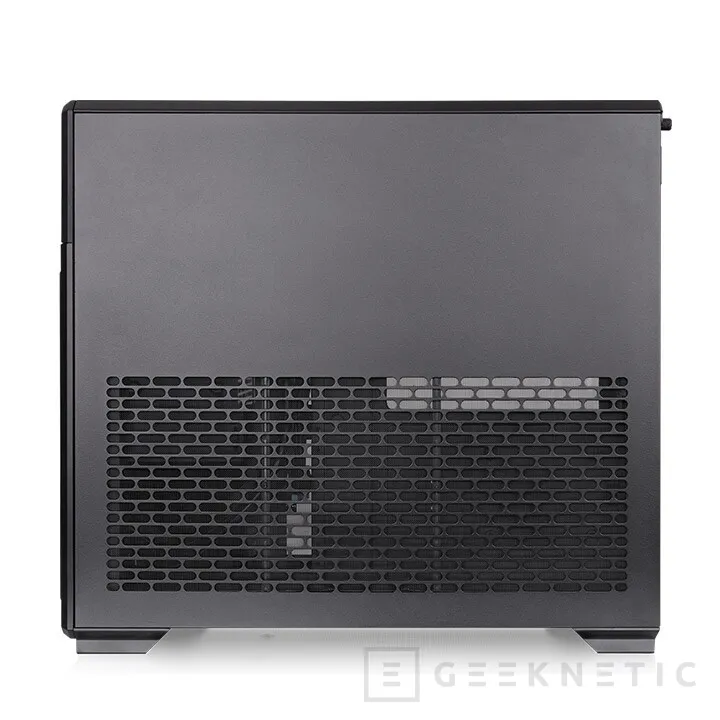
In numbers, the TR300 declares dimensions of 419 by 205 by 467 mm. The compatibility information that is most looked at before paying is usually that of the graphics, and here the announced limit reaches 410 mm in length. For air heatsinks, the maximum height is 165 mm. And for the source, the chassis supports drives up to 260mm.
In storage, the configuration supports two 3.5-inch drive bays and three 2.5-inch drive bays. It is not a case designed to live on mechanical drives, but it does offer a reasonable combination for anyone who wants a main SSD and a couple of drives for library or copies.
Front ports: the minimum, but with USB-C
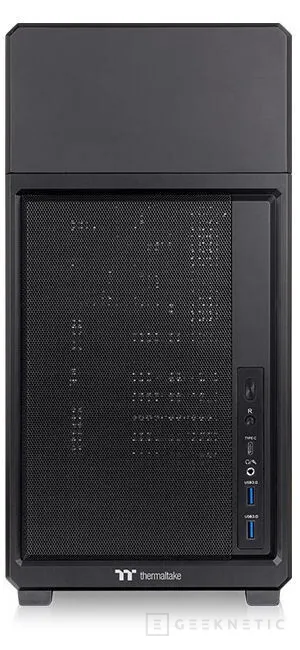
On the front I/O panel, the TR300 includes a USB Type C port, two USB 3.0 and audio jack. It is a sober selection, but with an important detail: USB-C is no longer a luxury, it is a necessity for current peripherals and mobile phones. Here it is present without forcing you to look for adapters or pull rear ports.
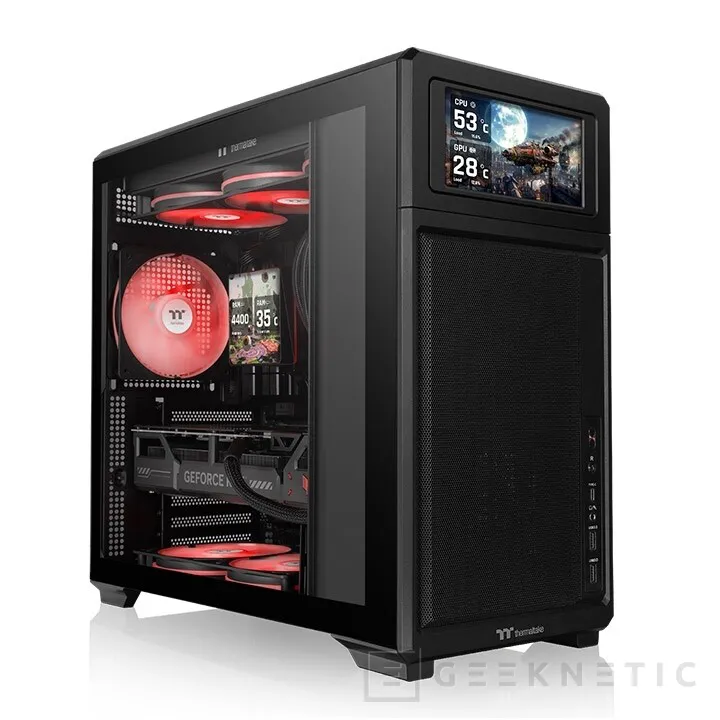
The box includes a panel 3mm tempered glass side. So far, nothing that has not been seen. The twist is in the optional accessory: a 6-inch LCD screen kit designed to display real-time information or personalized content, such as images or GIFs.
The screen is managed with the TT RGB Plus software and is integrated with an app called TT PlayLink. The promise is twofold: monitor system data and customize the front with more than just ARGB strips.
Why this design may be popular in 2026
The idea of moving the font to the front is not just aesthetic. It responds to a reality: graphics have grown, radiators have been standardized and clean assemblies depend on there being space for cables and air. A chassis that gives you several mounting positions for the source allows you to prioritize according to your case, which is exactly what is most valued when you are not building a catalog PC.
And if you are also interested in a more interactive front, the LCD screen kit adds that touch of customization that many are looking for today.
