
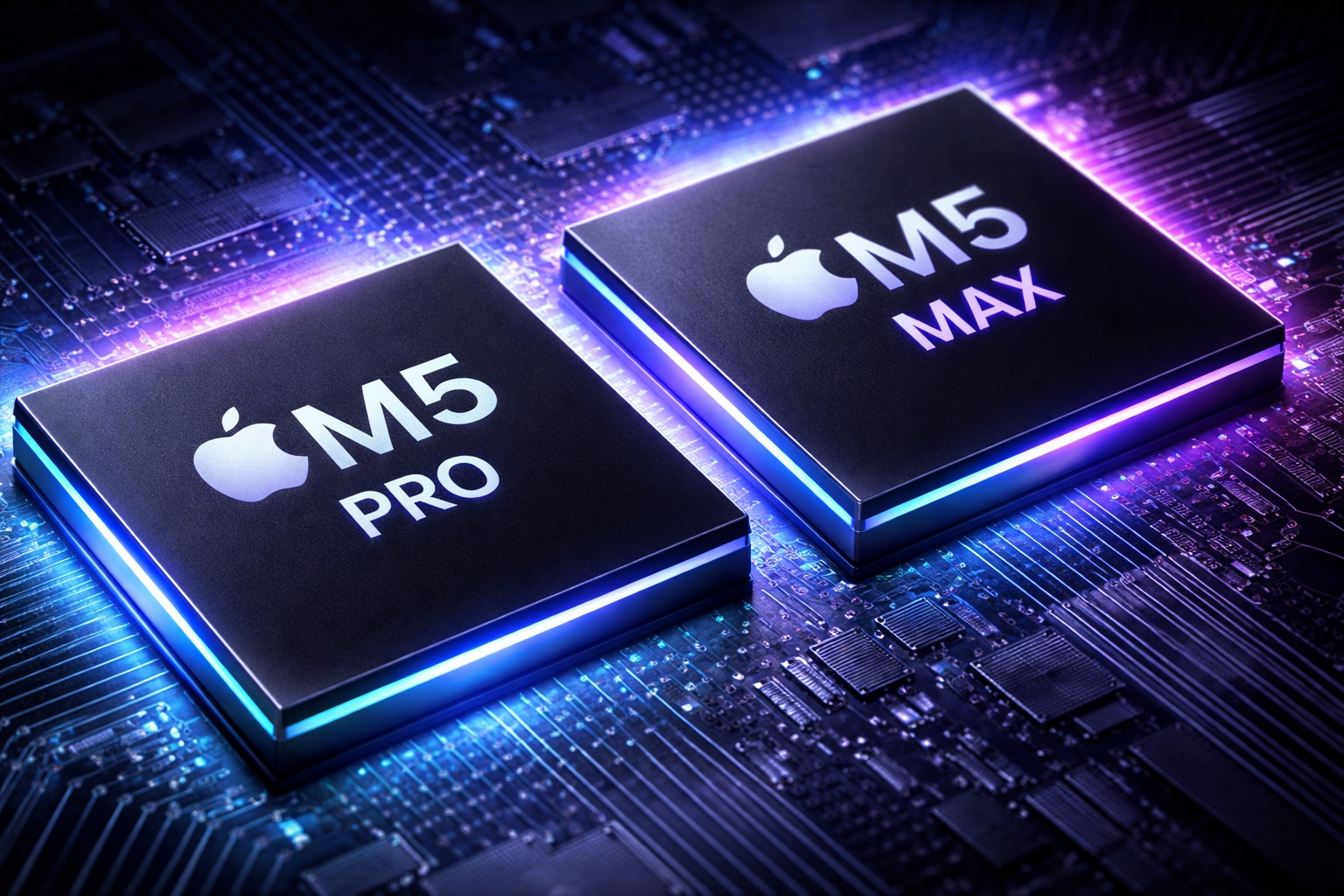
Apple is preparing an important change in the packaging of the M5 Pro and M5 Max so that heat stops being the annoying guest
Each generation of Apple Silicon brings the same conversation, just with new numbers: performance, efficiency and, when work gets serious, temperature. In thin laptops, the thermal margin is what it is. You can have a very efficient chip, but when you push the CPU and GPU at the same time, heat builds up and the system has to decide whether to maintain speed or kick back.
A new rumor suggests that Apple wants to attack that bottleneck from a less visible place: the packaging of the chip. The idea would be that the next M5 Pro and M5 Max move from InFO technology to a focus on 2.5D packaging supported by SoIC MHwith two clear objectives: improve dissipation and reduce internal resistance, in addition to increasing manufacturing performance.
InFO versus 2.5D: the change is not in architecture, it is in how it is built
InFO, acronym for Integrated Fan Outis a packaging technology designed for thin designs, where efficiency and thickness rule. In complex chips, however, there comes a point where that approach starts to hit its ceiling. According to the information handled, 2.5D would enter precisely to give more margin when silicon grows in size and ambition.
It is necessary to clarify the concept: 2.5D does not mean a stacked chip as in full 3D, but rather a packaging that allows several blocks to be integrated very closely, usually on an interposer or common base, with high-density connections between them. The result is usually more flexibility: you can divide functions into different blocks and connect them with less penalty than if you separated them on the board.
Furthermore, it is mentioned SoIC MH, an integration technique cited as part of the approach. The interpretation here is that Apple would be looking to combine packaging solutions to achieve more performance per watt in sustained loads, which is where laptops suffer.
Why heat matters even if the chip is efficient
The chip can be efficient and still get very hot when stressed. In fact, The problem is not only the energy consumed, but how it is concentrated. In a large monolithic design, hot spots are generated that a simple thermal solution, such as a single heatpipe, may have a harder time dissipating.
A revealing example appears in this rumor: a MacBook Pro with M4 Max is cited in a configuration with 16 CPU cores and 40 GPU cores, reaching a peak consumption of 212 W under heavy load and temperatures of 110 degrees. It is also mentioned that even an M5 could reach 99 degrees under stress. These are figures that explain why the thermal debate is still alive even in efficient architectures.
This is where 2.5D makes sense: If you can distribute the heat between several blocks, you reduce the hot spot and make it easier for the system to distribute the load without throttling. You don’t need to reinvent a laptop’s cooling system if you get the heat to distribute better from the source.
Manufacturing and cost: when packaging is also a supply strategy
There is another less romantic reading: the cost. The rumor suggests that by separating blocks such as CPU and GPU, they could be tested independently and the defective block replaced without throwing away the entire assembly, which reduces waste and can improve manufacturing performance.
This connects with a reality of 2026: the pressure on components such as memory. If the ecosystem tightens, any technique that increases yields and reduces failures becomes attractive, even if the end user only notices that the laptop withstands an export or a long compilation better.
Probable calendar: MacBook Pro in March and the shadow of thermal design
The same information places the 14- and 16-inch MacBook Pro with M5 Pro and M5 Max as candidates for a March launchmaintaining a thermal solution similar to that of the previous generation. If that is true, the packaging change would become even more important: it would be the way to gain margin without touching the inside of the chassis too much.
Of course, we are talking about rumors, and in this area Apple does not confirm anything until the stage. But the logic fits with the evolution of Apple Silicon: Each jump adds more GPUs, more cores and more transistors, and the challenge stops being just manufacturing in an advanced node. The challenge is to sustain performance when the user does what these chips invite them to do: press without fear.
If the move to 2.5D materializes, it won’t be an improvement that can be seen on a specs table, but it will be one that will be noticeable in long sessions. And that, in the real world, is where generations are won.
