

Mozilla accuses Microsoft of pushing Copilot in Windows 11 with dark patterns and backing down under pressure
Mozilla has once again attacked Microsoft, this time for the way in which it has deployed Copilot within Windows 11. In a new blog post, the organization maintains that the company did not limit itself to offering its artificial intelligence assistant as another option, but rather pushed it through automatic installationsdefault settings and increasingly visible integrations in the system.
The most direct criticism focuses on the Microsoft 365 Copilot application. According to Mozilla, this app began to be installed automatically on computers with Microsoft 365 desktop applications, without clear notice or express consent on the part of the user. Although Microsoft ended up temporarily withdrawing that forced deployment last month, the company still kept the app in the start menu and activated by default.
For Mozilla, this change of course does not respond to a spontaneous reflection on the user experience, but to the pressure accumulated by complaints. The organization interprets that Microsoft only began to moderate the presence of Copilot when the rejection became too evident, a reading that fits with the recent debate about the removal of shortcuts to AI in some Windows 11 apps. What we told you today about how Copilot is leaving Notepad, although the AI functions remain, helps to understand this approach.
The dispute goes beyond Copilot and puts the focus back on Edge and default values
The accusation does not stop at the artificial intelligence assistant. Mozilla maintains that the deployment of Copilot follows a pattern seen before in Windows, where Microsoft would have used its dominant position to favor its own services. This list includes the use of the dedicated Copilot key on Copilot+ PCs, its integration into the taskbar and Previous decisions linked to Edge and to the default browser.
The organization remembers, for example, that the Windows search bar opens results in Edge outside of the user’s default browser. He also reproaches that Outlook and Teams continue to open links directly in the Microsoft browser and that Windows does not offer a simple prompt so that another browser can ask to be the default with a single click. Overall, Mozilla sees a strategy aimed at forcing behavior to benefit Microsoft.
This criticism links with a dispute that goes back a long way. Mozilla has been denouncing for some time that Windows complicates the change of browser and takes advantage of moments such as initial configuration or migration to a new computer to return prominence to Microsoft applications. The arrival of Copilot, according to this reading, would not have inaugurated a new model, but rather expanded a way of designing the system where the user’s real choice is conditioned.
Mozilla tries to contrast this model with an optional and easy-to-disable AI
Faced with this approach, Mozilla has taken advantage of the clash to vindicate its own strategy with artificial intelligence in Firefox. The organization defends that these functions should appear as optional tools and not as layers imposed by the system. Take as an example the arrival in Firefox 148 of a switch that allows you to completely block the AI functions integrated into the browser.
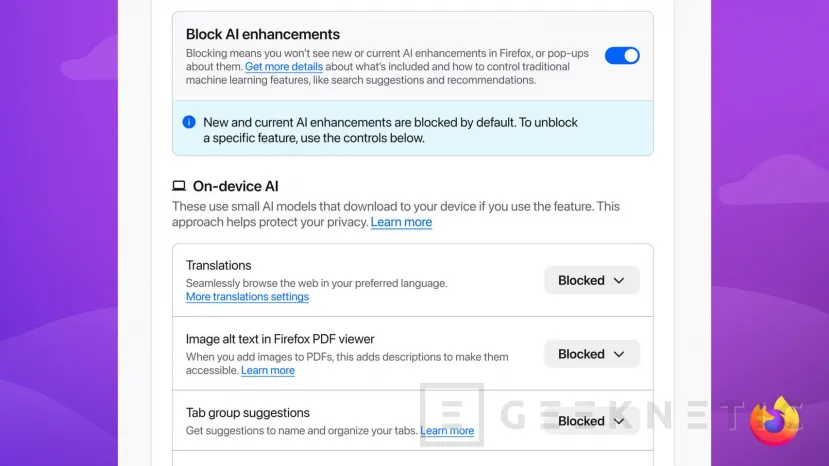
More than a technical comparison, the message is political and competitive. Mozilla comes to say that the problem is not that Microsoft integrates artificial intelligence into Windows 11, but how it does it and under what conditions. In his opinion, when a large platform only rectifies after a massive reaction, it ends up setting the rules of the market and makes it difficult for other alternatives to compete in a balanced ground. Curiously, the Firefox community has been quite harsh with its vision of AI, showing a frontal rejection of any of the initiatives to integrate this technology into the browser.
Be that as it may, the dispute thus leaves a clear reading for Windows 11. Copilot’s partial retreat does not close the debate on artificial intelligence within the system, but rather reopens a broader discussion about consent, design and platform power. Mozilla is using that context to insist on an old idea in a new wrapper, namely that Microsoft is still taking decisions designed for your business first and then for the user. Of course, expecting otherwise would be quite illusory, especially if we are talking about a big tech.
