
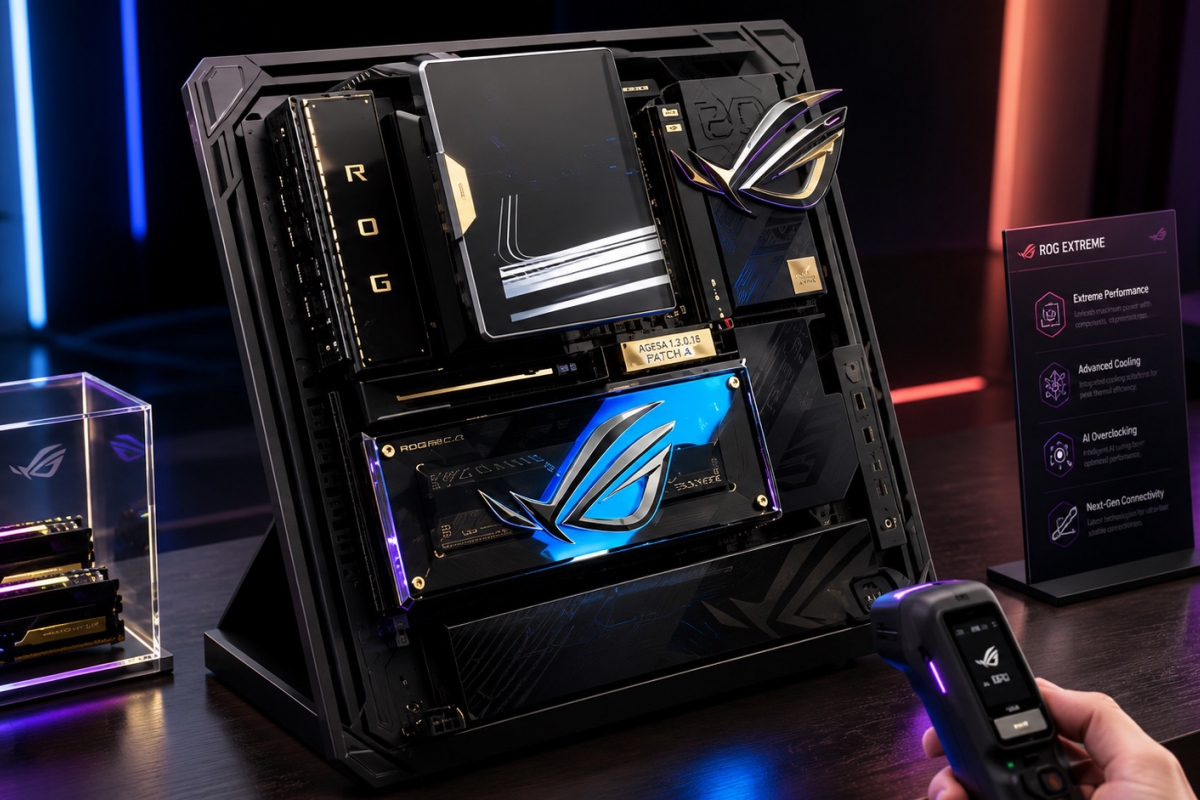
ASUS brings back TSME encryption on X870, B850 and X670 boards with a new beta BIOS
ASUS has begun to distribute a new batch of BIOS in beta phase for its AM5 motherboards that returns a function that many users considered lost: the TSME support on Granite Ridge series Ryzen processors that do not belong to the PRO range. The update arrives for X870 ranges, B850 and X670and marks the first visible implementation of this patch for a wide group of AM5 boards.
TSME, short for Transparent Secure Memory Encryption, is an AMD technology that transparently encrypts the contents of the system’s RAM without the user having to configure anything manually. Its main function is to protect the data stored in memory against physical attacks or unauthorized access, something especially relevant on computers that handle sensitive information.
Which boards are affected and what BIOS versions to look for
ASUS deployment is not uniform between ranges, and each family of boards receives a different BIOS version. According to the published information, the X870 series boards mostly go to the BIOS 2401while the B850 models are upgraded to the BIOS 1686. In the case of the X670 range, the jump depends on the specific model, and users may encounter the BIOS 3901 wave BIOS 3886 depending on the plate they have installed.
This difference in numbering between families is common in ASUS update cyclessince each board starts from a different BIOS base depending on its release date and the hardware revisions it has received. What is relevant in this case is that all these versions share the same objective: reintroduce TSME support that had been lost in previous firmware revisions for Ryzen 9000 processors without PRO suffix.
A solution that is still in beta phase
It is worth keeping in mind that this is a beta BIOS.not a final version available on the official support page for all models. This means that, for now, not all users will find this update listed as a stable download for their specific board, and the rollout will expand over time as ASUS validates the behavior in different configurations.
For those who depend on a stable system, especially in work or production environments, the usual recommendation in these cases is to wait for ASUS to release the final versions before updating. Beta BIOSes usually incorporate specific improvements, such as in this case TSME recovery, but they can also bring with them small side effects that are only detected after a longer period of testing by the community.
AGESA 1.3.0.1b Patch A, the basis of the patch
The change that has made this recovery of TSME possible comes from AGESA 1.3.0.1b Patch Athe microcode that AMD distributes to motherboard manufacturers so that they can integrate it into their own BIOS versions. This new revision of AGESA explicitly adds TSME support for platforms based on Ryzen 9000and its arrival through ASUS confirms that the manufacturer has already begun to distribute this patch among its catalog of AM5 boards.
The fact that this feature specifically affects non-PRO Granite Ridge models is relevant because it shows that the loss of TSME was not a deliberate decision limited to a specific segment of AMD’s catalog, but rather an issue that ended up affecting a broader portion of the Ryzen 9000 series processors. The correction through AGESA confirms that the problem was solved at the microcode level and not through individual adjustments on each board.
What AM5 board users should do
Owners of X870, B850 or Since this is an ongoing rollout, some models may take longer to receive the update than others, especially those released more recently or with lower sales volume.
As with any BIOS update, it is recommended to follow the usual flashing procedure: check the currently installed version, download the corresponding file directly from the manufacturer’s official website and avoid interrupting the update process at any time, since a corrupt BIOS can render the motherboard inoperative. For X670 boards, pay special attention to the exact model before choosing between BIOS 3901 and BIOS 3886since installing the wrong version on the wrong board can cause compatibility problems.
At the moment, ASUS has not confirmed a specific date for these beta BIOSes to become stable versions available for the entire affected AM5 catalog. What is confirmed with this move is that the company is already actively working on restoring a security feature that many Ryzen 9000 users had seen disappear without prior explanation in previous firmware updates.
