
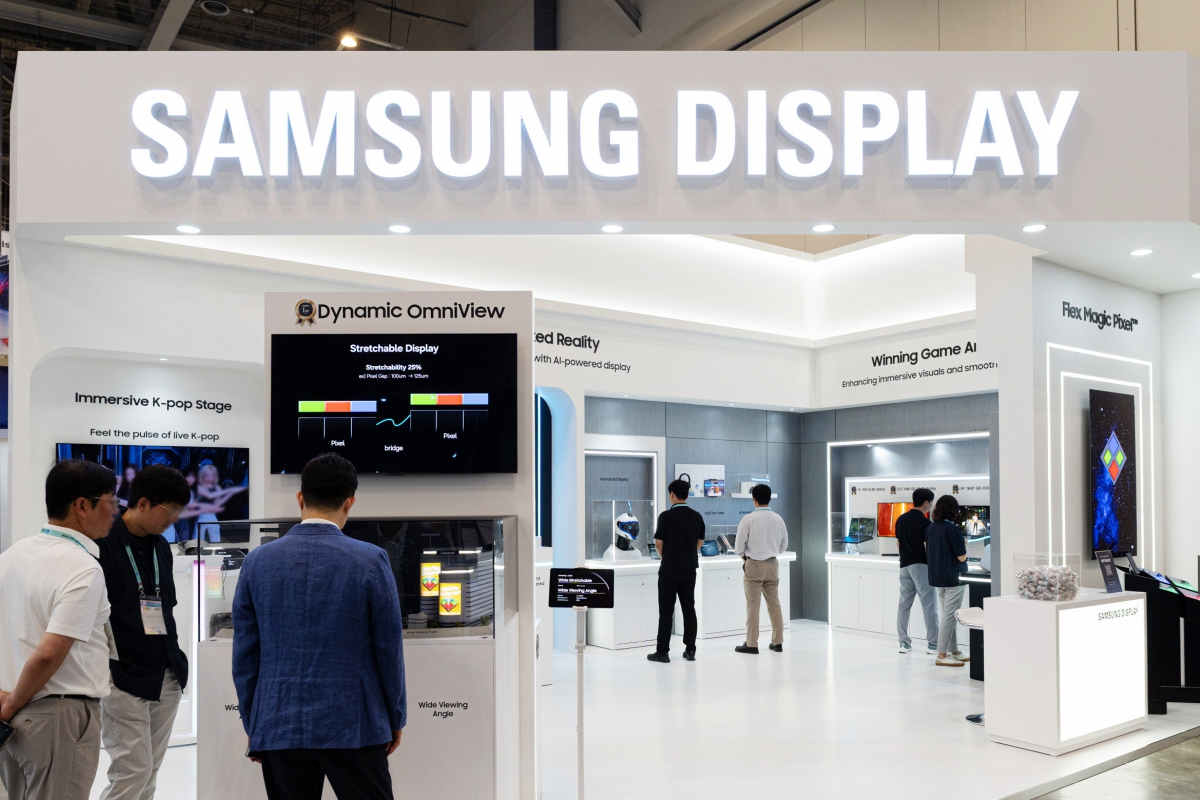
Samsung Display shows its first 300 Hz OLED panel for laptops, in 16-inch format
Samsung Display has publicly shown its first 300 Hz OLED panel for gaming laptops. The new 16-inch panel has been demonstrated at IMID 2026, held in Busan (South Korea)where the company presents it as the first self-emissive screen for laptops capable of operating at that refresh rate.
The firm, a subsidiary of Samsung Electronics dedicated to the manufacturing of panels, has chosen to show the product at an industry event rather than at a commercial launch, something common when there is not yet a laptop manufacturer ready to integrate it into a final model.
Only three confirmed data for now
Samsung Display has only confirmed three specifications of this new panel: a size of 16 inches, 2.5K resolution and a refresh rate of 300 Hz. The signage at the stand itself refers to the panel as “16” WQ OLED 300Hz”. The company has not revealed maximum brightness, HDR certification, response time or the exact resolution in pixels, data that normally accompanies this type of panel announcement.
This lack of technical details is common in demonstrations of this typewhere the panel manufacturer usually prioritizes showing the viability of the technology to potential partners rather than offering a complete technical sheet to the general public.
What changes with 300 Hz on a laptop OLED panel?
Until now, gaming laptops with very high refresh rates almost always relied on IPS panels, capable of achieving high figures more economically than OLED technology. The jump to 300 Hz in a self-emissive panel Adds to that speed the advantages of OLED, such as absolute blacks and faster response times per pixel, in theory without the contrast compromise that IPS panels usually have at those frequencies. Samsung Display has not detailed in this demonstration the specific response time of the new panel, so this practical comparison against the competition is still pending confirmation with official data.
This panel assumes a step forward compared to the range of OLED panels for laptops that Samsung Display showed at Computex 2026. At that time, the company explained that its OLED panels for gaming laptops moved between 165 Hz and 240 Hz, the latter figure being the highest among the OLED panels for laptops that were already in production.
At that June event, Samsung also showed off its Ultra Slim OLED panel for laptops and a 31.5-inch QD-OLED monitor panel at 4K and 360 Hz. The company then demonstrated a 16-inch OLED laptop with 2,560 x 1,600 resolution, although it has not confirmed whether the new 300 Hz panel shares that same pixel resolution.
Tandem panels and a growing presence in laptops
Samsung Display has recently expanded its OLED technology for laptops on other fronts. Last month, the company began supplying tandem OLED panels capable of reaching up to 1,600 nits of brightness and VESA DisplayHDR True Black 1400 certification to Lenovo, while ASUS, Dell and MSI are also preparing their own products with this technology. Samsung has not indicated whether the new 300 Hz panel shown at IMID uses this same tandem structure, which combines two emissive layers to improve brightness without sacrificing power consumption.
The Samsung exhibitor at IMID also includes the 31.5-inch QD-OLED panels at 4K and 360 Hz, and 34 inches in 21:9 format at 360 Hzboth previously announced by the company. The 34-inch model has been in mass production since December 2025, while manufacturing of the 31.5-inch panel at 4K and 360 Hz is planned for the second half of 2026.
This combination of panels aimed at both laptops and desktop monitors reflects the Samsung Display’s strategy to cover the gaming segment high-end products in several formats at once, instead of concentrating your ads on a single type of product per event.
Samsung Display has not provided a production schedule nor has it indicated which laptop manufacturers could integrate this new 300 Hz panel. This lack of specificity contrasts with the rest of the panels shown at the same stand, where the company has provided mass production dates or confirmed partners such as Lenovo.
Events like IMID function precisely as a showcase for this type of technology in the phase prior to its commercial adoption, where laptop manufacturers and other potential clients can evaluate the panel before committing to integrating it into a final product. Until Samsung Display confirms partners and specific dates, the 16″ WQ OLED 300 Hz will remain a laboratory demonstration, without presence yet in any product available to the public.
