
Google tightens Gemini limits and reinforces a trend: subsidized AI is a thing of the past
Google has begun implementing a major change to access to Gemini Apps from May 17, 2026, and the effect is already being felt among paying users. As explained by the company itself in its official documentation, Gemini leaves behind a more request-based system and begins to operate with limits calculated by computation, which are recharged every five hours until reaching a weekly limit. In practice, this means that not all queries weigh the same and that a single complex interaction can eat up a lot of the available margin.
The question is how that consumption is now measured. Google indicates that the use It will depend on the complexity of the promptthe functions used and the length of the chat. This especially affects high-end models and functions, such as Pro, Deep Research, Extended Thinking, Deep Think or the generation of images, video and music. That is, the closer the use is to what is expected of a professional tool, the faster the user can reach the limit.
We already have the first reactions on Reddit. Several Gemini Pro users describe scenarios in which a few long responses are enough to use up a very large portion of the five-hour quota. Some speak of five or seven real messages before the brakes, while others estimate that a minute and a half output can consume around 20% of the available margin. These are not official Google figures, but they do reflect a shared feeling, namely that the service has become much less usable for intensive work.
Gemini is becoming more and more like Claude in the bad for the heavy user
The change reminds us of something. In recent months, a similar drift had already been seen in other services, especially in Claude, where the limits have become more visible and more restrictive as advanced reasoning and expensive models gained prominence. At the moment, ChatGPT seems to withstand this pressure better in everyday use, although it also depends a lot on the plan and type of task. What is beginning to become clear is that the market is moving away from that initial stage in which almost everything seemed abundant, flexible and relatively cheap.
In Gemini, in addition, it was previously easier to estimate how many queries could fit within normal use. Now that changes because the cost of each interaction can vary abruptly depending on the context. A simple task may barely count, while a long conversation with advanced features may complete the five-hour stretch in a very short time. For those who use the tool occasionally this may go unnoticed. For those who try to really work with it, the change weighs much more.

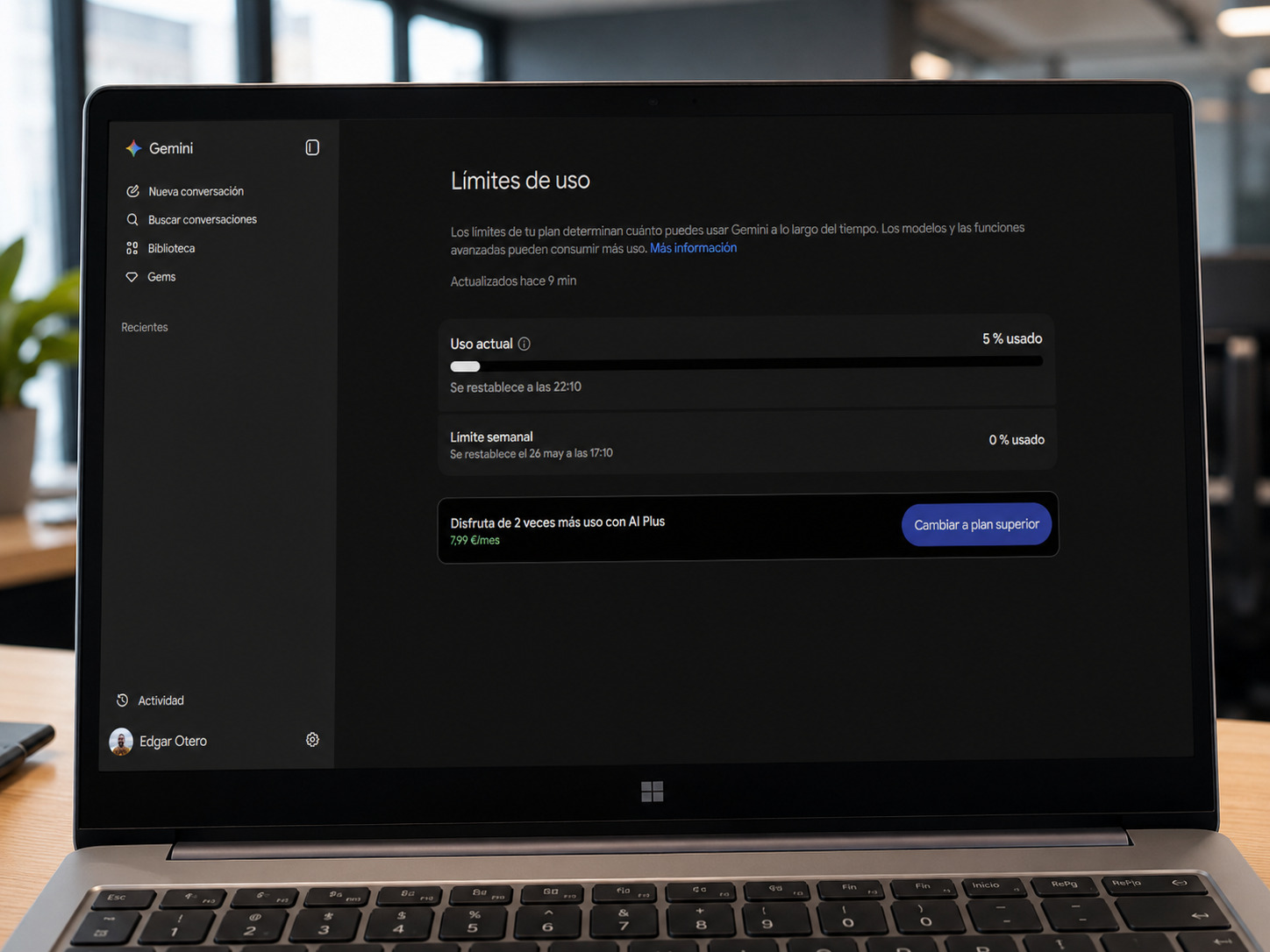
Google has also enabled a clearer way to check that status within the app itself. Users can check their limits by entering the sprocket and then Limits of usewhere both the consumption for the current period and the daily and weekly limits appear. This detail brings Gemini closer to an increasingly common model in commercial AI, where not only the contracted plan matters, but also how much real computing the provider is willing to grant before temporarily cutting off access.
The problem is no longer just the limit, but the end of subsidized AI
If we do a broader analysis, it is evident that all this is not just about Gemini. What we are seeing is the progressive erosion of a stage in which many companies offered more capacity than the business could probably sustain in the long term, even for a company that controls hardware and software. While the goal was to grow, attract users, and get the market used to new tools, it made sense to absorb some of the cost. Now the context changes. Advanced models consume a lot, the competition no longer gives away as much and the platforms are beginning to transfer that pressure to the end user.
That opens up an uncomfortable dilemma for anyone thinking of integrating these tools into serious workflows. If access to the most useful models depends on increasingly harsh limits, the promise of productivity becomes more fragile. Not because technology has ceased to have value, but because it is beginning to show its real price. And that price, at least for now, points to the fact that the time for subsidized AI is running out.
