
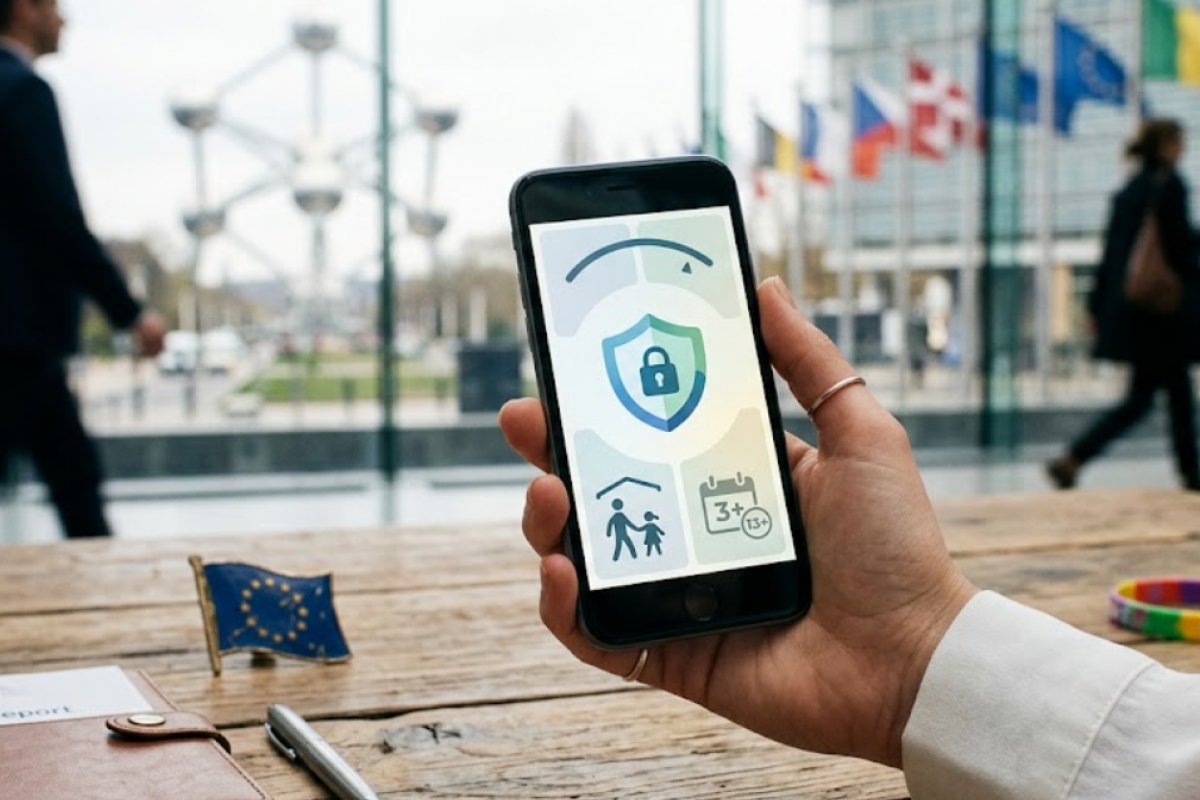
The European Union will prohibit access to social networks for minors under 13 years of age. There will be an open source age verification app
The President of the European Commission, Ursula von der Leyen, today confirmed the European Union’s roadmap for restrict minors’ access to social networks. Based on the conclusions of the Special Panel on Child Online Safety, the Commission will present a new bill after the summer to set a minimum starting age on these platforms.
Although specific ages have not yet been indicated, the report on Children’s Online Safety advises that children under 13 years of age should not access social networks for mental health reasons.
60% of minors have experienced psychosocial problems due to exposure to harmful content on social networks
The report indicates that young Europeans currently spend between four and six hours a day in front of screens and almost a 60% have experienced psychosocial problems or exposure to harmful content on social media.
The Commission’s text points directly to algorithms and responsibility of large technology companies. Europe will require that the companies behind social networks and their addictive algorithms have to prove that their services are not harmful by default.
In fact, with the current Digital Services Act (DSA), the European Union has already initiated action against the addictive design of TikTok and Meta, and the goal now is to increase this regulatory pressure.
The report on which the future law will be based also recommends that Children under three years of age should not have any type of exposure to screens. From that age onwards, access to social networks should be gradual, always under the supervision of an adult and with time limits.
- Children under 3 years: Zero screens.
- Children under 13 years old: The report recommends widespread restriction of access to social media. In fact, the text warns that handing over a smartphone at age 12 instead of 13 increases the risk of mental health problems.
- From 13 to 18 years: An autonomous use is proposed, but “evolving”, limiting itself to social networks that are appropriate for their level of development.
There will be an open source age verification app
To enforce these future limitations, the European Commission will develop a Own age verification app. Von der Leyen has detailed that it will be a open source tool and aimed at preserving privacy, designed so that parents regain control over when and how their children access the Internet.
The fact that it is an open source tool puts an end to certain criticisms of this measure, alleging that it could be a way to end user privacy.
The final regulations that will give legal form to all these issues will be presented at the return of the summer.
