
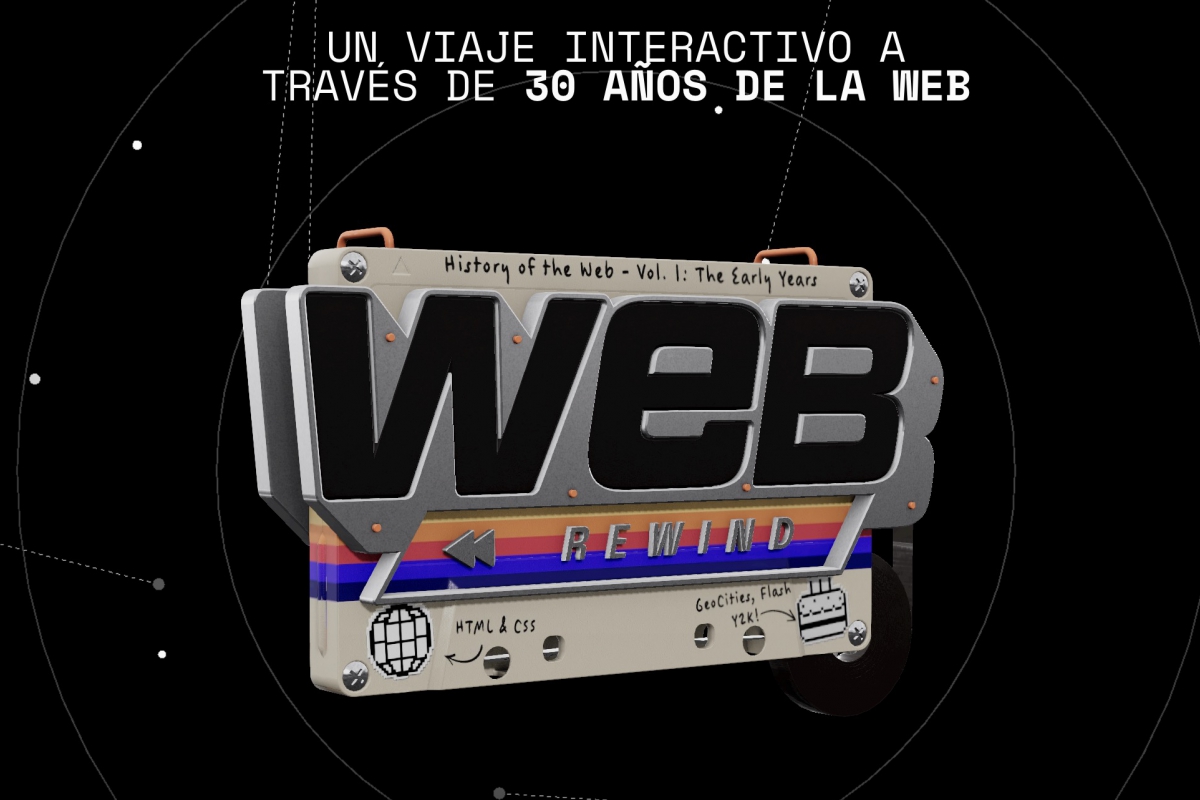
an interactive museum of three decades of Internet history
Opera, the Norwegian browser founded in 1995, has launched Web Rewindan interactive website that works as an Internet time machine to celebrate its three decades of existence. I can tell you that, if you are nostalgic for the WWW, you will not be disappointed. The project allows explore key moments in the history of the web from 1996 to 2026from the characteristic sound of modems connecting to viral phenomena such as MySpace or the first memes that circulated on the Internet.
Unlike a simple chronological archive, Web Rewind is presented as an interactive digital museum where users can freely navigate between different eras. The mechanics are simple. Simply hold down the space bar to jump randomly between different historical moments, although there is also the option to go directly to a specific year or use the Rewind button to access specific events.
The platform includes audio narration that guides the user through each exhibit, similar to having a museum curator explain the pieces. Visitors can control the sound from a button in the top right corner, where there are also options to change languages. Each page has link icons at the bottom left that allow you to share specific moments with other users.
Opera has turned the anniversary into more than just a nostalgic project. The company is accepting contributions from the public about his most memorable memories from the Internet. The authors of the three best contributions will win a trip to CERN in Geneva, Switzerland, the physics laboratory where the World Wide Web was born in the early 1990s. Those interested have until March 27, 2026 to send their memoirs in text format of up to 500 characters, with the option of attaching images or videos.
Thirty years of survival in a tremendously ruthless market
That Opera has reached 30 years is no small feat in a sector where most browsers have disappeared. Founded in Norway in 1995 and officially launched as a browser in 1996, the company has seen competitors like Netscape Navigatorwhich came to dominate the market with more than 80% share, or Internet Explorer, which replaced it as the absolute leader, have ended up becoming extinct.
Today, with Chrome controlling the global market, Safari dominating on Apple devices, Edge as a Microsoft alternative, and AI-based agentic browsers, Opera maintains a modest but steady share. Its survival is explained, in part, by having pioneered features that later became industry standards.
Opera was the first browser to introduce tabs to navigate with multiple pages open in the same window, a function that seems basic today but was revolutionary at the time. He also invented Speed Dial, the system of visual shortcuts to favorite pages that other browsers would later copy. In 2002, Opera brought the first full web experience to mobile phones, years before smartphones became popular.
Other innovations included mouse gestures for faster browsing, turbo mode to compress data on slow connections, and advanced zoom functions. Many of these features ended up being adopted by competitors, cementing Opera’s role as an industry-wide think tank. Currently, the company is also working to expand its specialized browsers, such as OperaGX for the world. gaming.
A tour of the best (and worst) of the web
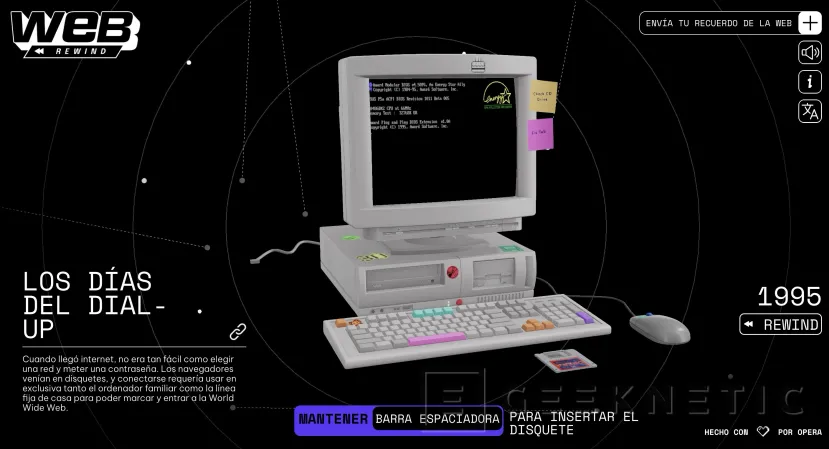
Web Rewind is not limited to showing static screenshots. Users can interact with digital artifacts designed to recreate real experiences. One of the most successful examples is a virtual PC with Windows 95 that can be turned on, where it is possible to insert virtual floppy disks and connect to the Internet through a 56k modem with its unmistakable sequence of beeps.
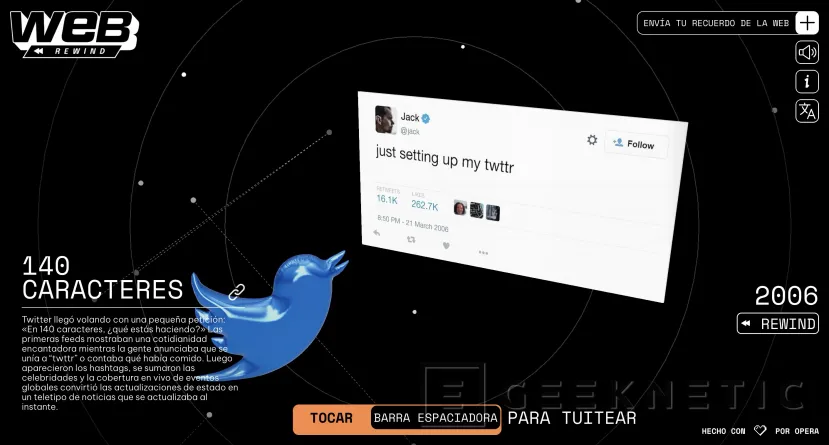
The platform dedicates space to milestones such as the birth of Google with its original minimalist design, the launch of Twitter with its initial limit of 140 characters or the arrival of DVDs on personal computers. MySpace also has its tribute, remembering the time when choosing the perfect song for your profile was a momentous decision.
Memes also feature prominently. The site includes everything from Dancing Baby and Badger Badger to Grumpy Cat and Overly Attached Girlfriend. Also brought back is the iconic “you have email” from AOL and the buzzing from MSN Messenger. There is even a simulation of LimeWirethe MP3 file sharing software, complete with error messages and spam pop-ups that anyone who used the tool will remember with a mix of nostalgia and frustration.
