
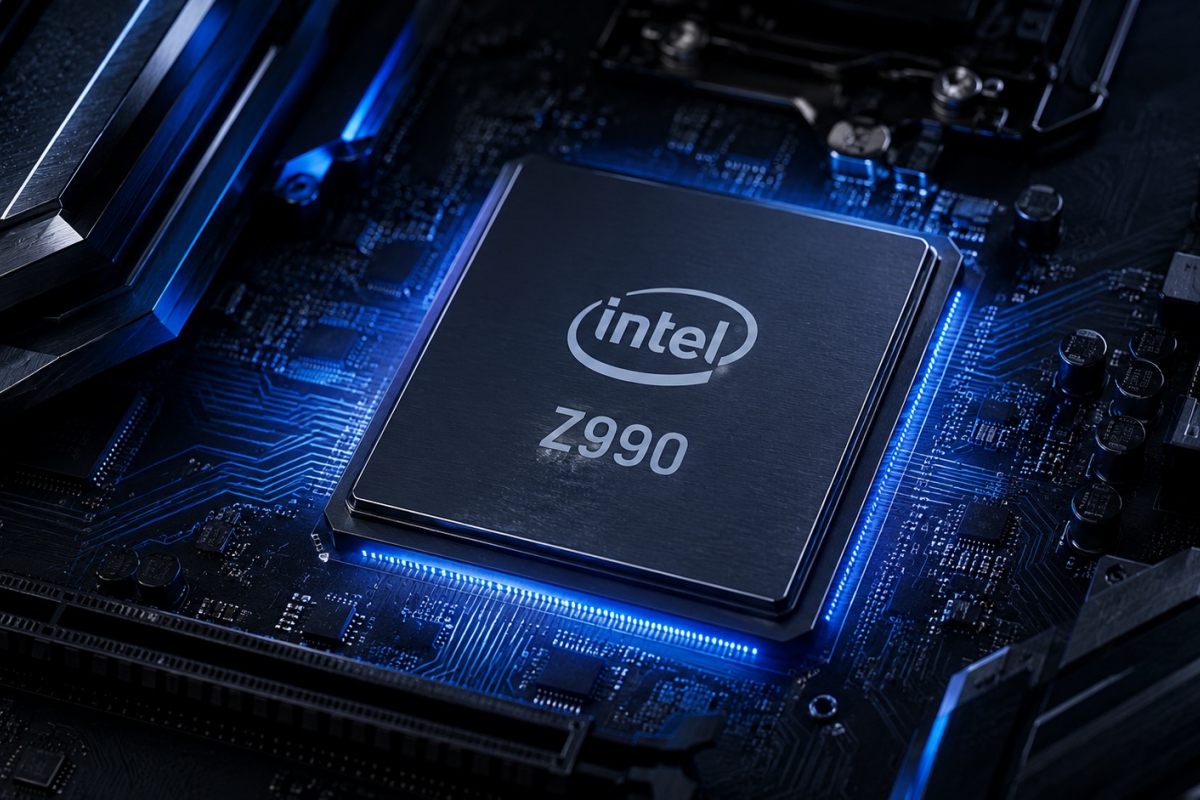
Intel revises Z990 chipset power guide and would allow up to 474W in dual-tile Nova Lake CPUs
Intel seems to be polishing the final details of its next desktop platform, and this time the focus is on the power supply of the motherboards. According to a new leak, the manufacturer has updated the power design guide for the chipset Z990the flagship of the future LGA-1954 family, with the aim of supporting the Nova Lake-S dual-tile compute processors.
The information comes from LC Tech Leaks, an account that has the support of Jaykihn, one of the leakers with the most experience within the Intel ecosystem. Depending on your version, the Z990 boards They would go from the two current 8-pin EPS connectors to three connectors of this typea change designed to sustain higher consumption peaks in high-end models.
The 474W figure and the real limit of Nova Lake CPUs
According to the leak, Intel’s new guide would reserve 474 W as the nominal PL2 limit for a dual compute tile SKUthat is, for Nova Lake-S processors that integrate two core chiplets in the same package. Any consumption above that figure would be reserved for overclocking scenarios with both dies active, not for factory operation.
Intel has not confirmed either these figures or the final requirements for the Z990 boards, so all information should still be taken as a leak subject to change before the official launch.
The number of connectors could depend on the board manufacturer
The leak qualified, after several users pointed out that a photograph of a license plate Z990 actually showed a different distribution of connectors: two 8-pin EPS plus one additional 8-pin PCIe type, a configuration that had been described as Intel’s original design basis for this chipset.
According to the source itself, the final number of power connectors on the Z990 boards will largely depend on each manufacturer. There will be models with three EPS connectors and others that remain with two, depending on whether the design points to a profile more oriented towards extreme overclocking or a more standard configuration within the same catalog.
The Intel 900 platform chipset family
Along with these details about the power, the leak also reviews the future range of chipsets of the Intel 900 platform for LGA-1954 socket. This family would include the models B960, Z970, Z990, Q970 and W980each one aimed at a different segment of the motherboard market.
Within that range, the Z990 chipset would be positioned above the Z970, with more input and output lines available and full support for overclocking, while the rest of the models (B960, Q970 and W980) would aim for more business or general use profiles without the same manual adjustment options on the processor.
GIGABYTE would have already shown a board with triple EPS connector
The leak also reminds that GIGABYTE already showed a motherboard without a confirmed name related to rumors about the Z990 chipset during Computex. In the photographs shown at the event, that board had three 8-pin power connectors, although neither the exact layout nor the final design that will reach the market have yet been confirmed by the manufacturer.
This detail fits with the idea that some manufacturers would already be working with the revision of three EPS connectors for their most ambitious models in the Z990 catalog, while others could choose to maintain a simpler configuration on boards aimed at an audience that is less demanding with overclocking and with tighter budgets.
What this change means for Nova Lake-S users
The jump to three EPS connectors on some Z990 boards is one more indication of where the consumption of high-end desktop processors is heading. Dual Tile Computing SKUs Nova Lake-S They will foreseeably concentrate more cores in a single package, which increases both the nominal consumption and the margin necessary for overclocking on high-end boards designed for that segment.
For the end user, this translates into more robust motherboards in their power sectionwith more phases and more connectors to distribute the current that reaches the processor, especially in the premium models designed to get the most out of these future CPUs. Those looking for a more conventional device will probably not notice relevant differences, since the Z990 boards with two EPS connectors will continue to be another option within each manufacturer’s catalog.
At the moment, neither Intel nor the motherboard manufacturers have officially confirmed any of this data, so it is advisable to wait until the launch of Nova Lake-S approaches to have a definitive image of both the power requirements and the final chipset offering of the 900 platform and the Z990 chipset itself.
Until that happens, the only thing that remains clear is that the generational leap in the LGA-1954 socket will not only bring changes in the processor itself, but also in the electrical design of the motherboards that accompany it, with the Z990 chipset as the protagonist of this transition towards more demanding consumption in the high range.
