
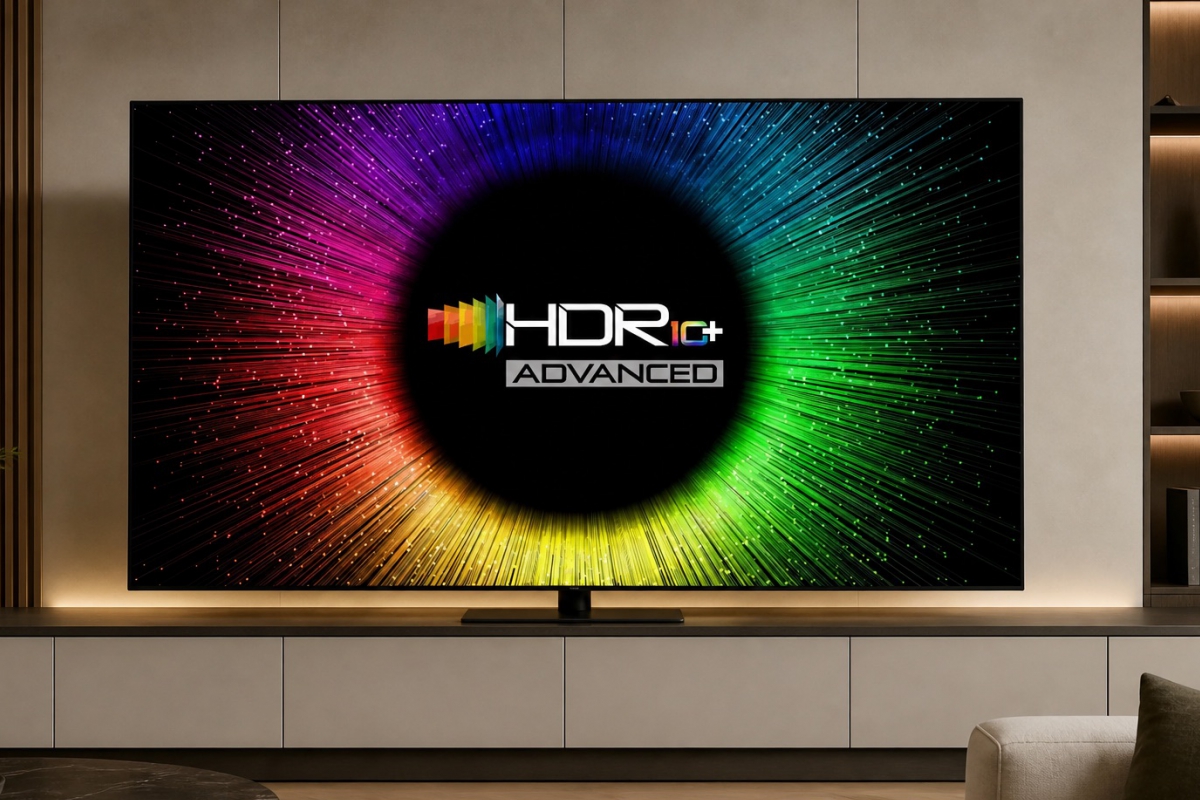
Samsung becomes the first brand to launch televisions with HDR10+ ADVANCED
Every few years, the television world agrees, or almost, to take a step forward in the way of displaying color and contrast on screen. Now it’s the turn of HDR10+ ADVANCEDthe latest evolution of the standard originally promoted by Samsung, and the South Korean wanted to make it clear that it does not plan to wait for other manufacturers to take the first step.
Samsung has confirmed that its 2026 televisions will be the first consumer models on the market to support HDR10+ ADVANCED. The news does not come alone: Prime Video will also become the first streaming service to offer content under this format globally, with a rollout that will begin in August 2026.
A standard that had been brewing behind the scenes for months
HDR10+ ADVANCED is not an afterthought. The HDR10+ Technologies organization formally announced this new standard on December 10, 2025, then pointing out MediaTek, panasonic, Roku, Samsung and TP Vision as part of the group of companies involved in its development. What remained to be confirmed was who would make the real leap towards the final consumer, and it was Samsung who has gone ahead of the rest of the sector to confirm the first commercial deployment of HDR10+ ADVANCED on televisions.
This nuance is important, because being among the technical supports of a standard is not equivalent to being the first to bring it to stores. With this announcement, Samsung ensures that it is the market reference when users start looking for televisions compatible with HDR10+ ADVANCED, something that usually translates into a non-negligible commercial advantage during the first months of life of any new format.
Richer metadata and self-adaptive motion processing
The update that HDR10+ ADVANCED brings is not limited to a simple marketing tweak on the HDR10+ that we already knew. The new format adds improved overall brightness metadata (what the industry itself describes as Enhanced Overall Brightness), as well as local tone mapping and image optimization that varies depending on the genre of the content being played at any given time.
The novelty that can be most noticed on a day-to-day basis is what Samsung has called intelligent motion smoothing. This feature allows compatible TVs to adjust their motion processing on a scene-by-scene basis, rather than applying a single fixed criterion to all content being watched, whether it’s a movie, series or sports broadcast.
Samsung has explained that this system can reduce motion smoothing when a movie is playing, thus respecting the original cinematographic appearancewhile applying more processing to sports content and other fast-moving scenes, where a smoother image is often preferable to the viewer. Of course, there is an important exception that should be taken into account: HDR10+ ADVANCED will not work on Samsung TVs when Filmmaker mode is activatedsince both technologies pursue image processing objectives that are incompatible with each other.
From HDR10 to HDR10+ ADVANCED, a leap that is noticeable on several fronts
To understand what HDR10+ ADVANCED really brings, it’s worth looking back. The original HDR10 worked with a single static metadata setting for the entire video, without distinguishing between darker or brighter scenes within the same piece of content. HDR10+ arrived later to address that limitation, introducing dynamic metadata fine-tuned on a scene-by-scene basis, with more precise tone mapping than its predecessor.
HDR10+ ADVANCED takes a step beyond all that. In addition to the dynamic tone mapping that HDR10+ already offered, it adds motion processing also based on metadata per scene, something that neither of the two previous versions contemplated, and allows content to be optimized differently depending on whether it is movies, sports, video games or other types of audiovisual material. It is, in short, a leap that affects both the most visible part of color and contrast and a field, that of movement on the screen, which until now was completely outside this type of dynamic metadata.
A launch with more questions than certainties for now
Despite the official confirmation, there is still a lot of ground to be made before users can enjoy HDR10+ ADVANCED in their living rooms. Neither Samsung nor Prime Video have yet confirmed which specific titles in the catalog will benefit from the new format at launch.nor have they published a complete list of compatible television models within the South Korean company’s 2026 range.
That Samsung is ahead in HDR10+ ADVANCED is not just a matter of showing off its technical specifications. The HDR10+ standard was born precisely as a royalty-free alternative to Dolby Visiona competing format that requires licensing payments from both television manufacturers and content producers.
Each new leap of HDR10+ ADVANCED reinforces that proposal compared to Dolby Vision, and Samsung, as the original promoter of the format, has the most to gain if it makes HDR10+ ADVANCED become the dominant standard in the television market in the coming years. The confirmation of Prime Video as the first compatible streaming service also adds a strong ally capable of dragging other platforms towards the new format, something that until now had been one of the weakest points of HDR10+ compared to the already consolidated Dolby Vision ecosystem.
